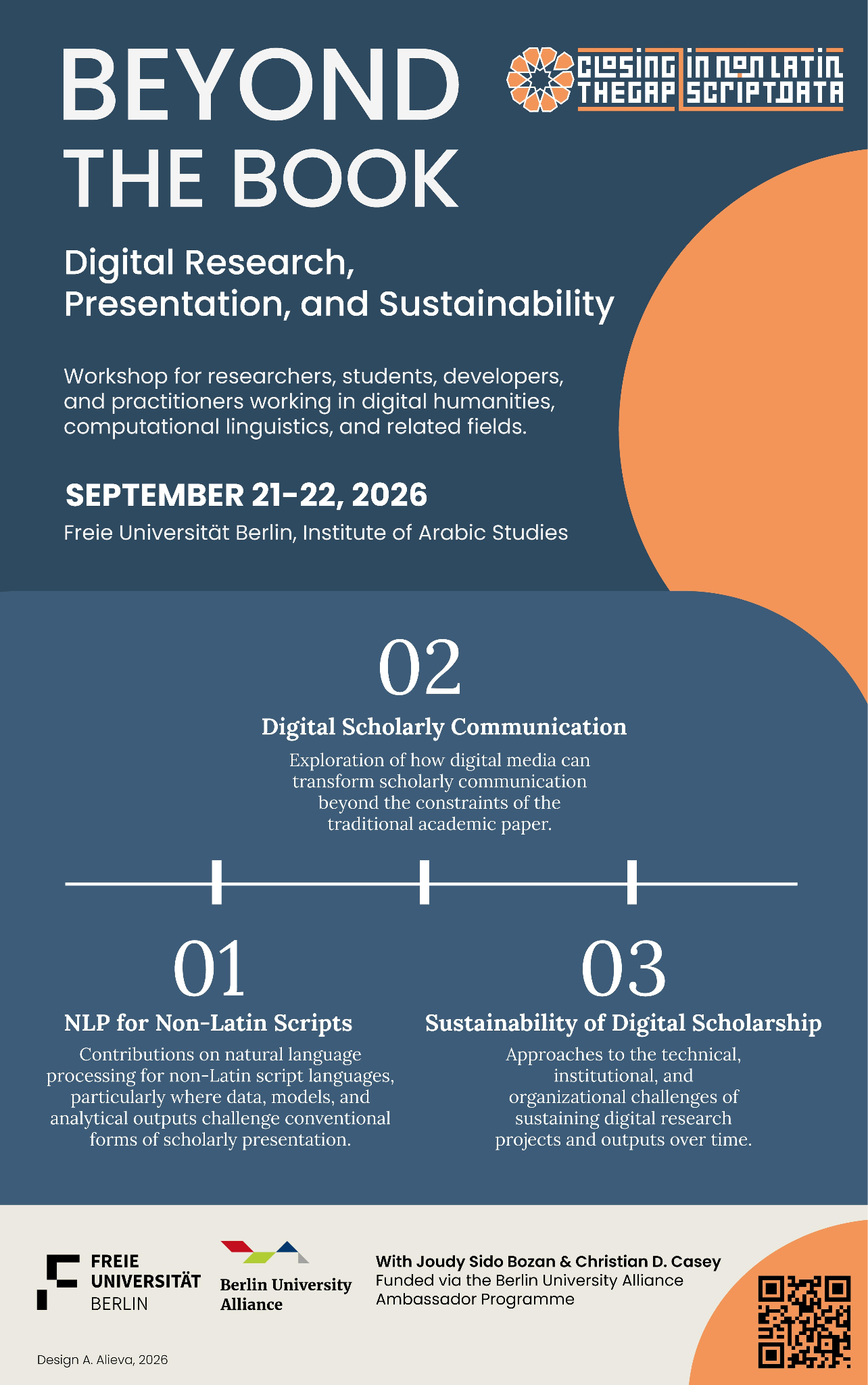
Beyond the Book · Freie Universität Berlin · 21–22 September 2026
Digital Scholarly Communications…
Keynote at Beyond the Book: Digital Research, Presentation, and Sustainability
Maxim Romanov
September 22, 2026 · The Evolution of Islamic Societies (c. 600–1600 CE), Universität Hamburg
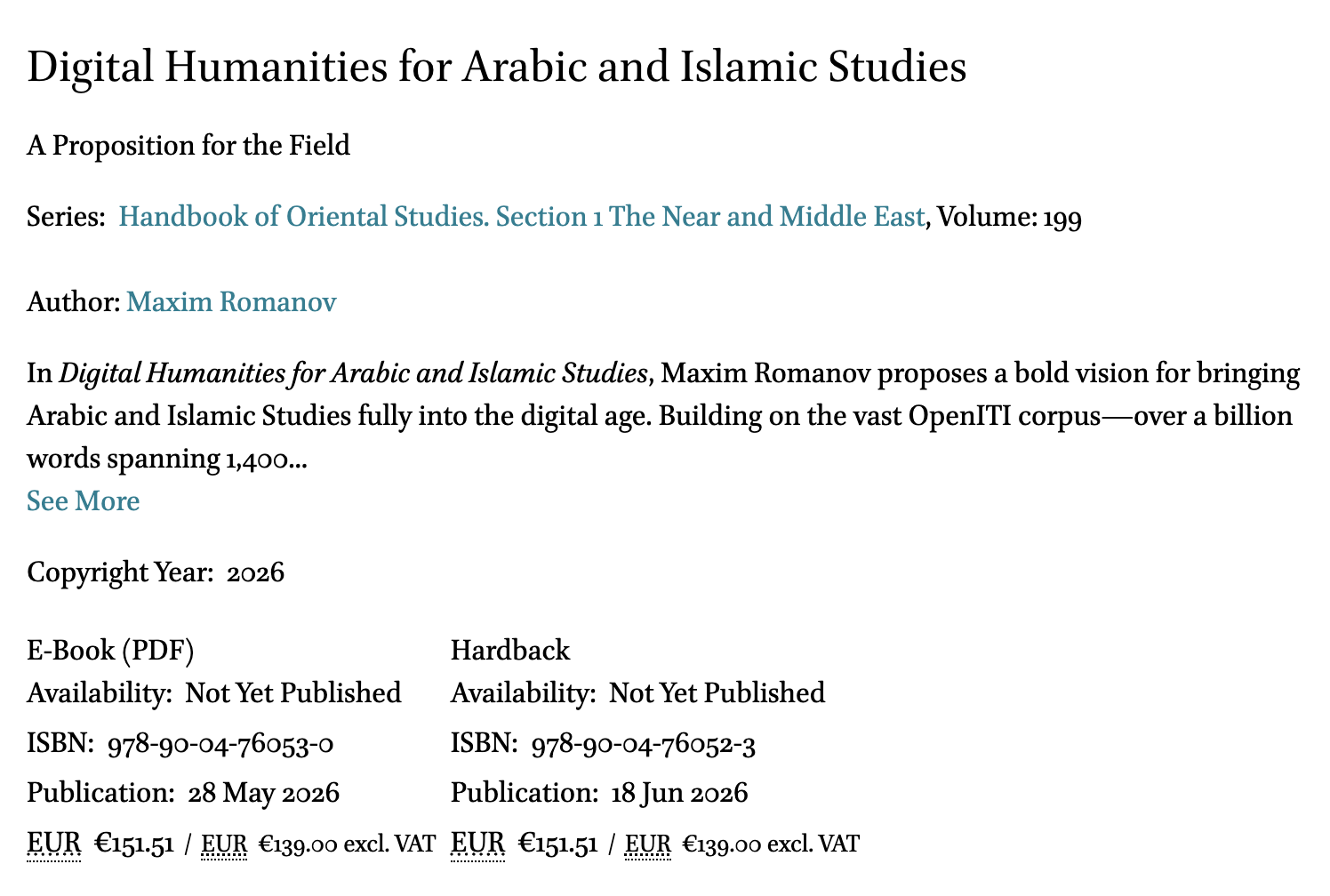
What’s in the book?
Three Chapters
A Pitch for the DH
Digital Avatars and Metaobjects
Computational Inquiries
In short, this book asks: What does it mean for our field when the entire library becomes a vademecum—something that, quite literally, “goes with me” everywhere? What new possibilities and responsibilities does this transformation bring?
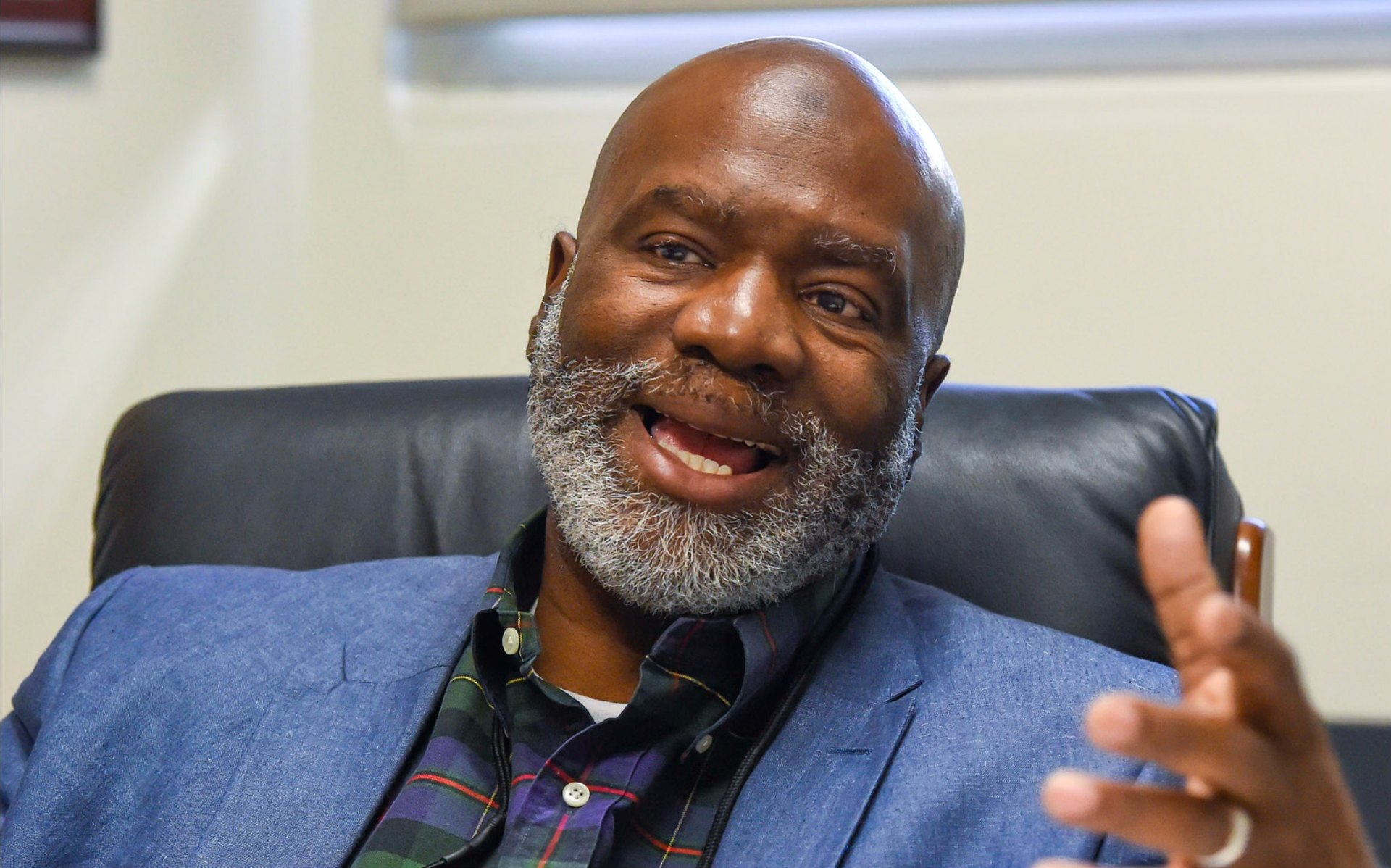
al-Jāmiʿ al-Kabīr? Shamela? C’mon, man, that is cheating!— Prof. Sherman Jackson
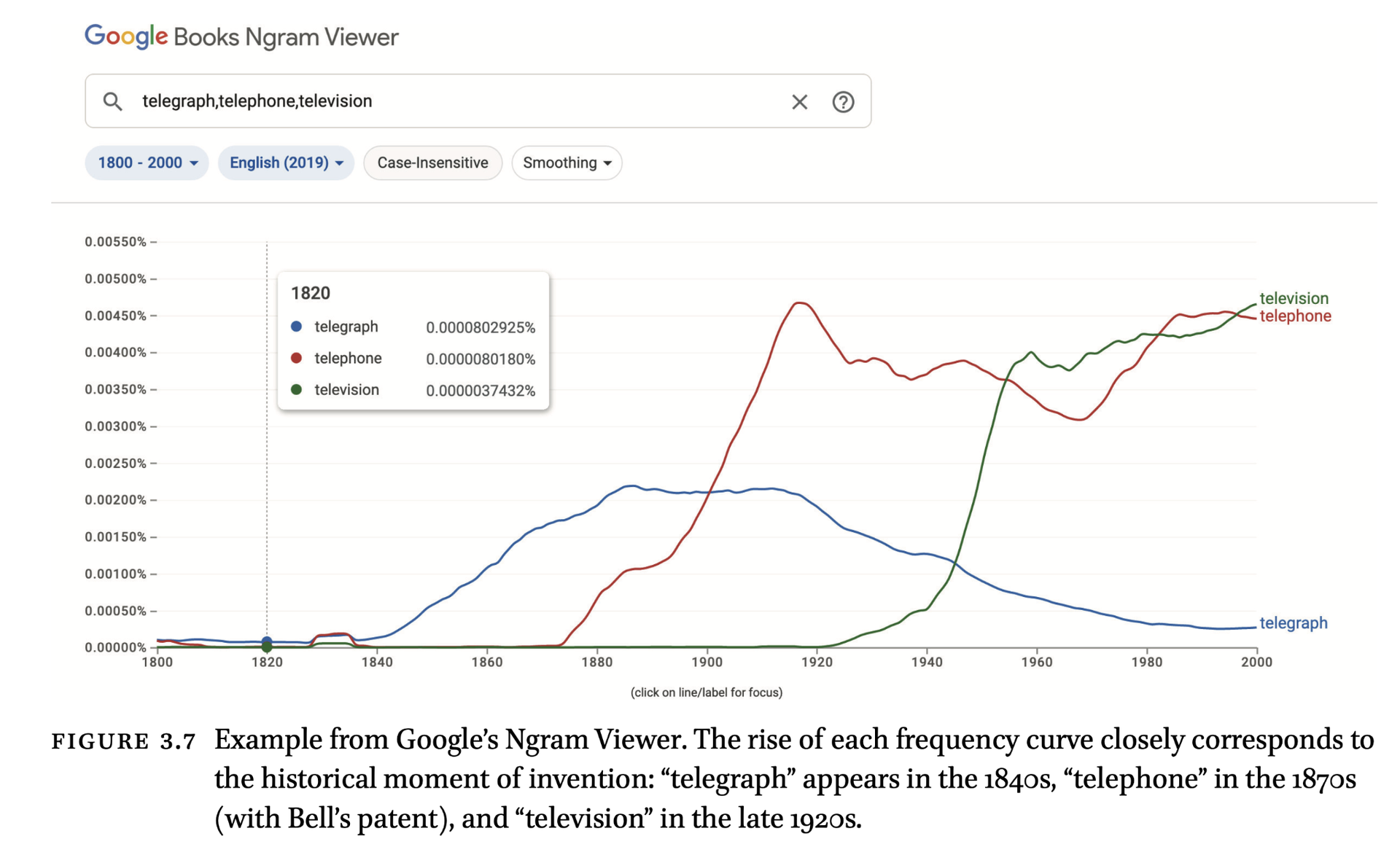
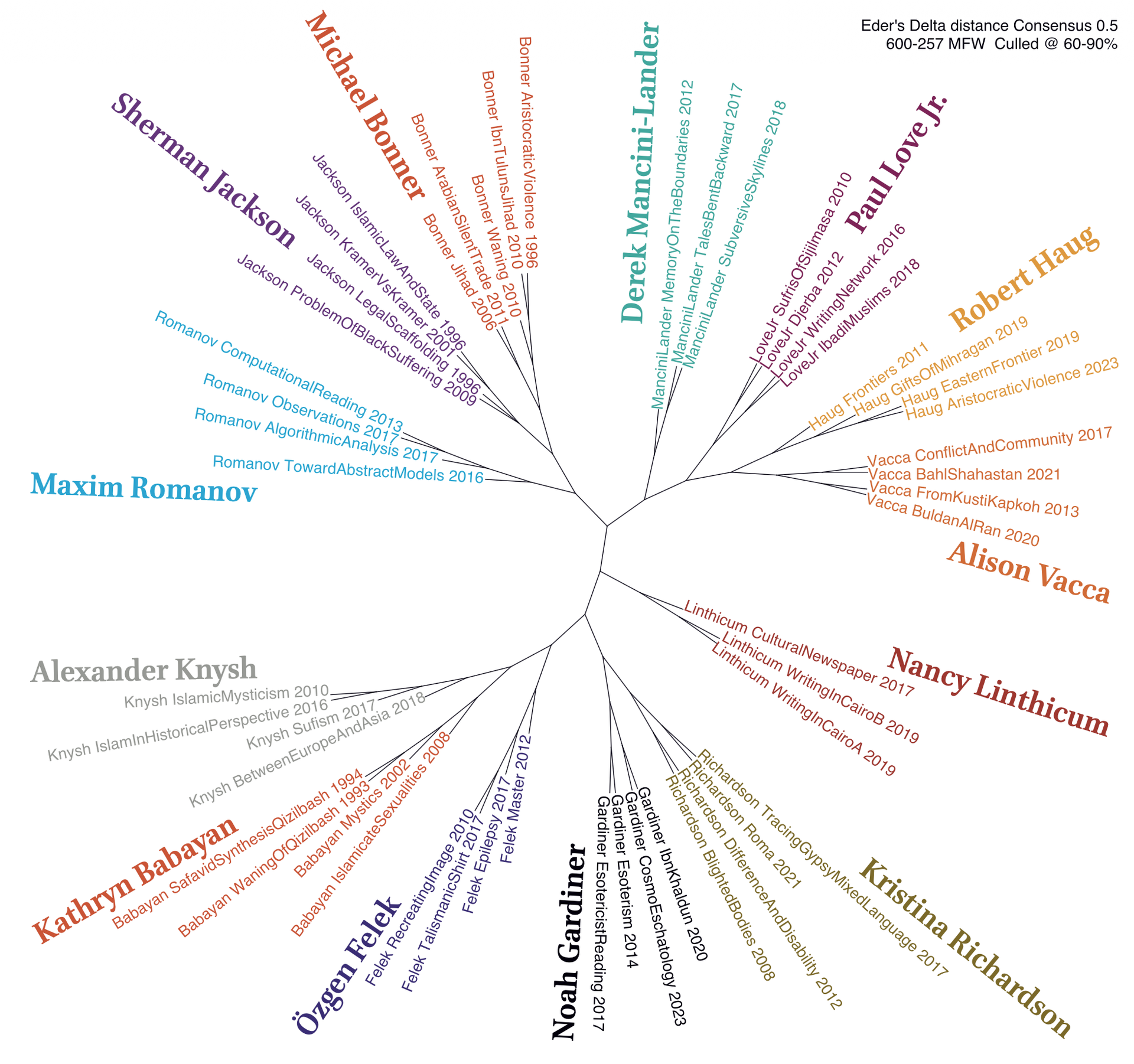
Tracing Concepts over time with The Secret Weapon
Senior Scholar
Decades of notes. Thousands of hours in the stacks. This kind of work was the prerogative of senior scholars.
Graduate Student
One searchable library. Hundreds of classical Arabic texts. A senior scholar visibly unsettled. A tool never acknowledged.
“Why would he? These weren’t ‘real’ books. Only books needed to be cited.”
Not the first revolution, not the last…
Oral/Aural
Written
Print
Digital
Unlike classicists — who have been digitizing Greek and Latin texts since the 1980s — scholars of Arabic and Islamic studies had almost nothing to do with the appearance of our digital corpus.
“A scan through recent academic publications can easily leave the impression that our digital corpus does not exist at all, or if it does, it is of relatively little consequence.” — Travis Zadeh, 2016
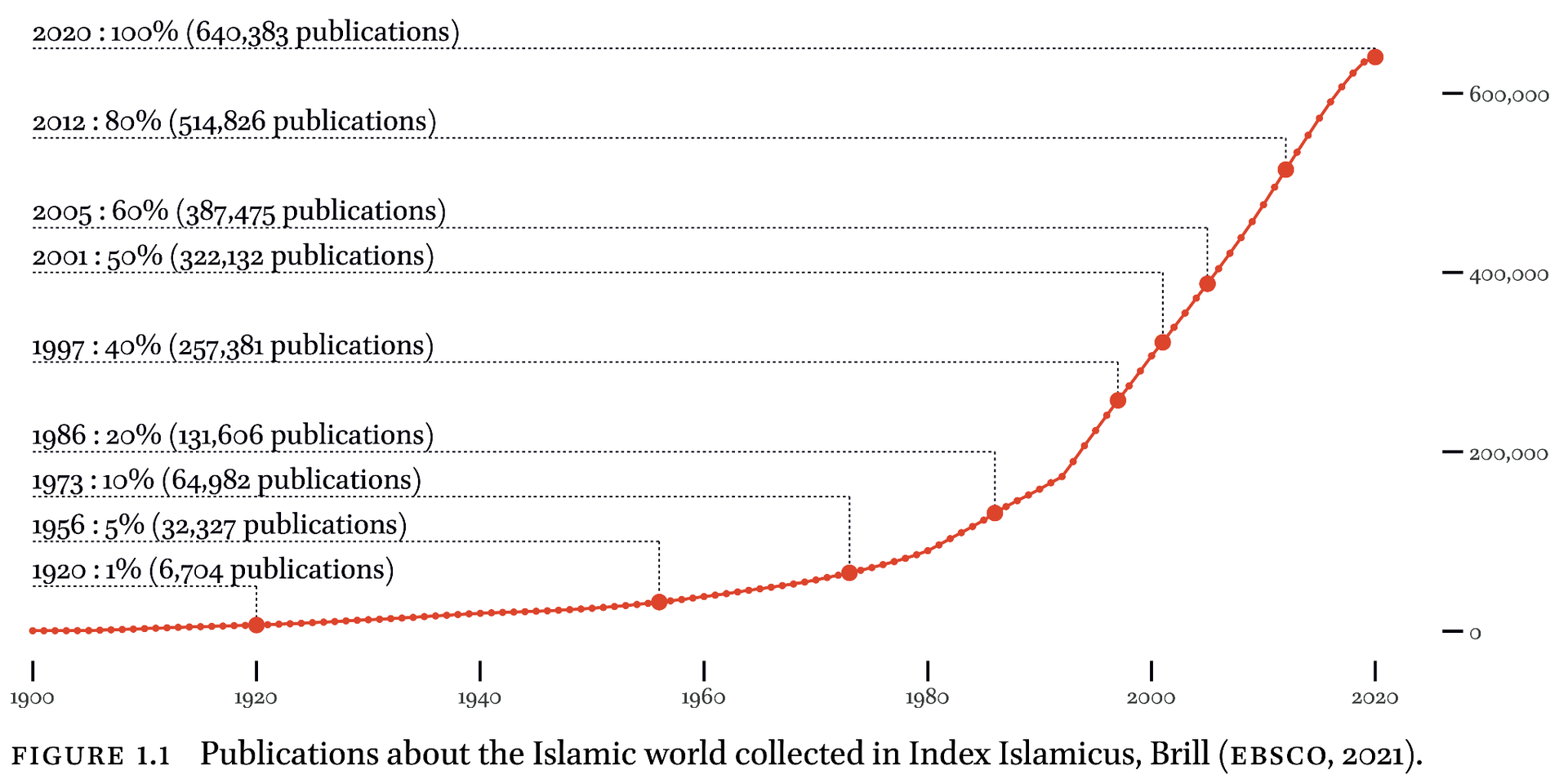
Mountain of information
Scholarship doubled between 2000 and 2020!
The Library That Arrived Unexpected
8,600+classical Arabic texts
1 billion+words in the corpus
1,300+years of written Arabic
A treasure without a map. A library without a methodology. A field that found itself unprepared.
What do we do when the entire library becomes a vademecum?!
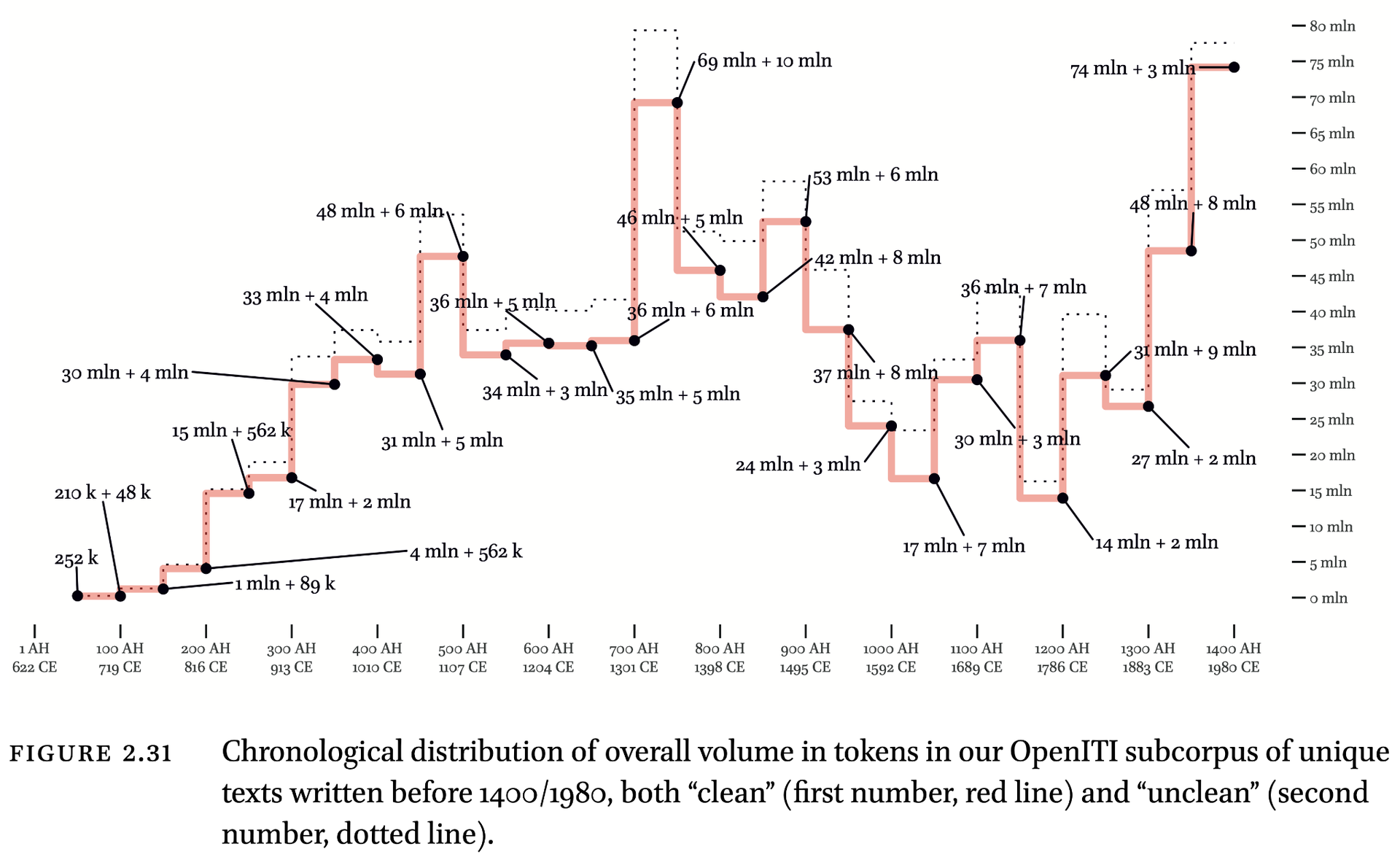
OpenITI, v. 2023.1.8 — “clean”
Our final subcorpus, based on version 2023.1.8, consisting solely of “clean” unique texts written up to 1400/1980:
– 2,783 unique authors (156 fewer than in the set above, or 94.69%)
– 7,058 unique texts (−407 fewer, or 94.55%)
– 927.37 million tokens before cleaning
– 868.81 million tokens after removal of most paraeditorial material and remaining “unclean” (93.68% of the uncleaned set)
But a corpus is also a historical source
Survival bias — what reached us
Editorial / digitization bias — what modern scholars chose to publish
Uneven genre and chronological coverage
Source criticism begins with the instrument.
The Proposition: Four Domains
IDigital AvatarsMachine-readable editions of manuscripts and printed books
IIMetaobjectsCorpora, databases, and linked open data at scale
IIIComputational MethodsStatistics, stylometry, and NLP adapted for Arabic
IVNetworksKnowledge networks: text, person, place, and time connected
Each domain depends entirely on the success of the preceding ones — no shortcuts.
Digital Pragmatism: born from necessity, not ideology
It is truly sustainable only if you can do it alone.
— Bare minimum technologies: limit without compromising necessary complexity
— Learn them deeply: no dependency on external technical support
— Automate repetition: your time is better spent elsewhere
“Simple, but not simpler.” “Laziness is the engine of the progress.”
Digital Pragmatism: born from necessity, not ideology
It is truly sustainable only if you can do it alone.
— Bare minimum technologies: limit without compromising necessary complexity
— Learn them deeply: no dependency on external technical support
— Automate repetition: your time is better spent elsewhere
“Simple, but not simpler.” “Laziness is the engine of the progress.”
+ LLMs
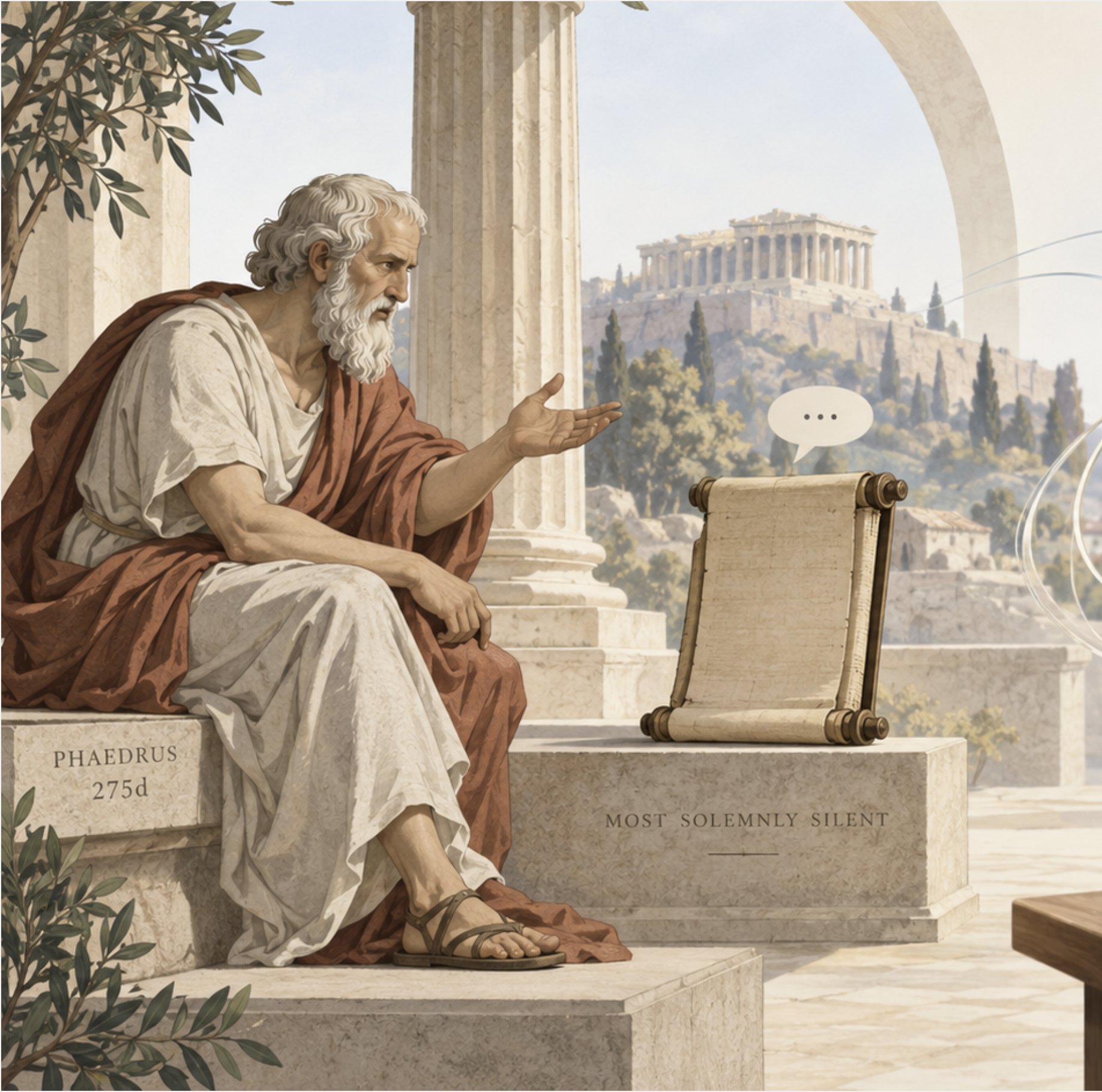
The irony of new media
The classical critique of books
“If anyone asks them anything, they remain most solemnly silent.”
— Plato, Phaedrus 275d
Writing was once suspect; today written texts are our scholarly gold standard.
The modern parallel
Now, knowledge from LLMs is suspect…
…yet LLMs bring dialogue back to reading.
The ultimate irony: technology restores the interactive conversation Plato feared was lost.
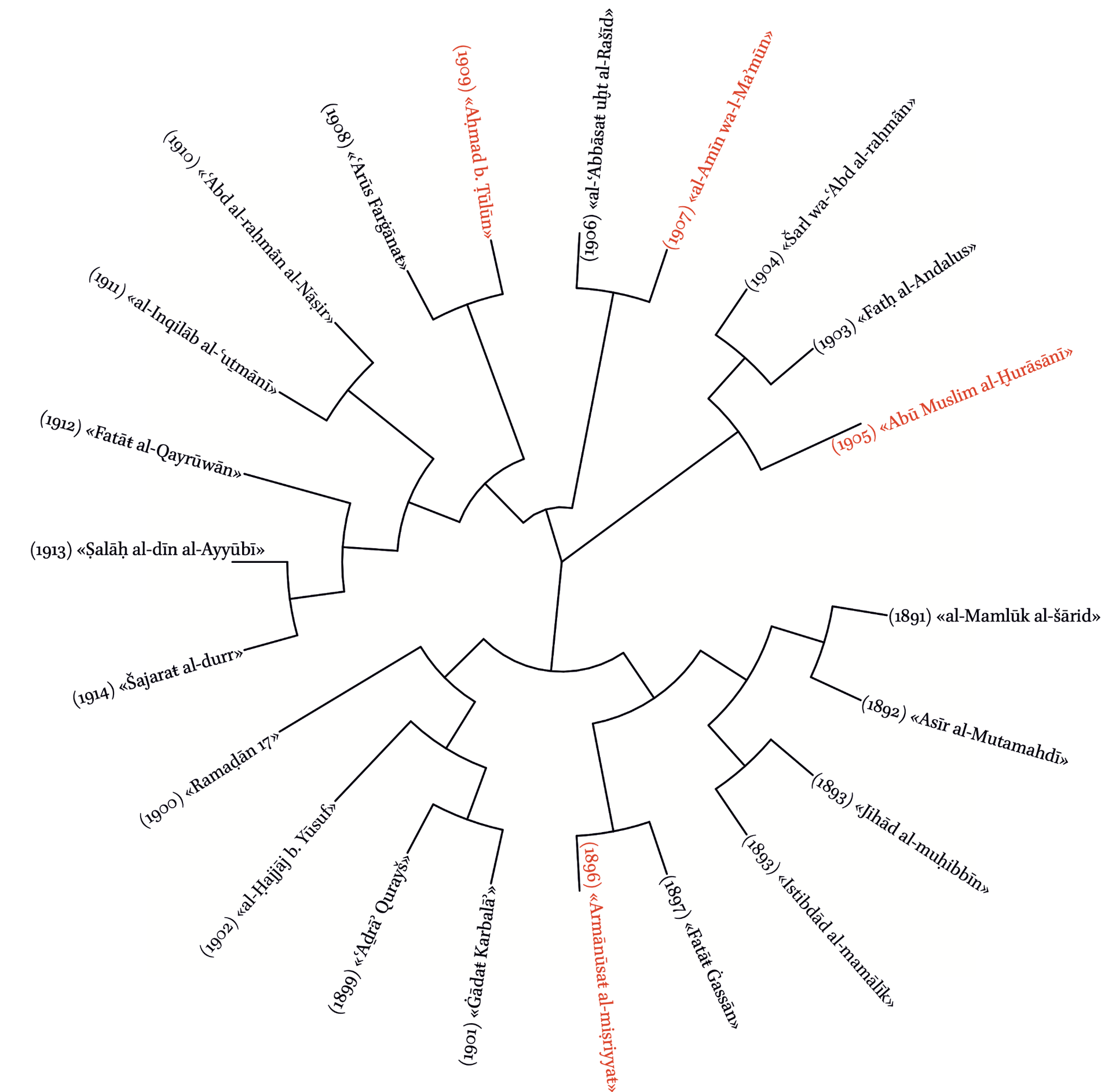
١Case Study 1: Tracing Term Usage
٢Case Study 2. Modeling Textual Typology
٣Case Study 3. Charting Linguistic Evolution
١Case Study 1: Tracing Term Usage
٢Case Study 2. Modeling Textual Typology
٣Case Study 3. Charting Linguistic Evolution
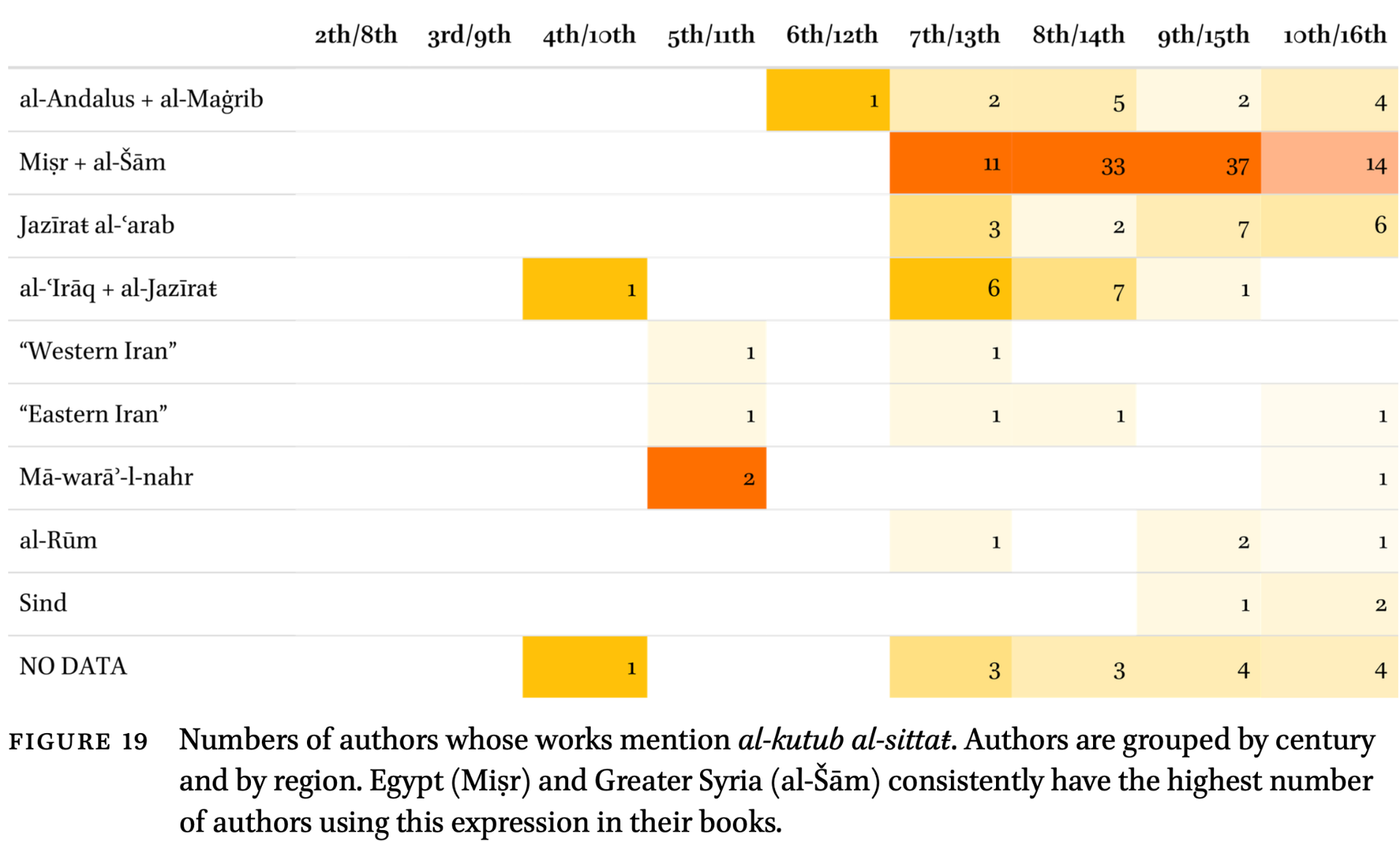
Case Study 1: Tracing Term Usage
2.1 From “The Devil’s Delusions” to Ḥadīṯ Studies
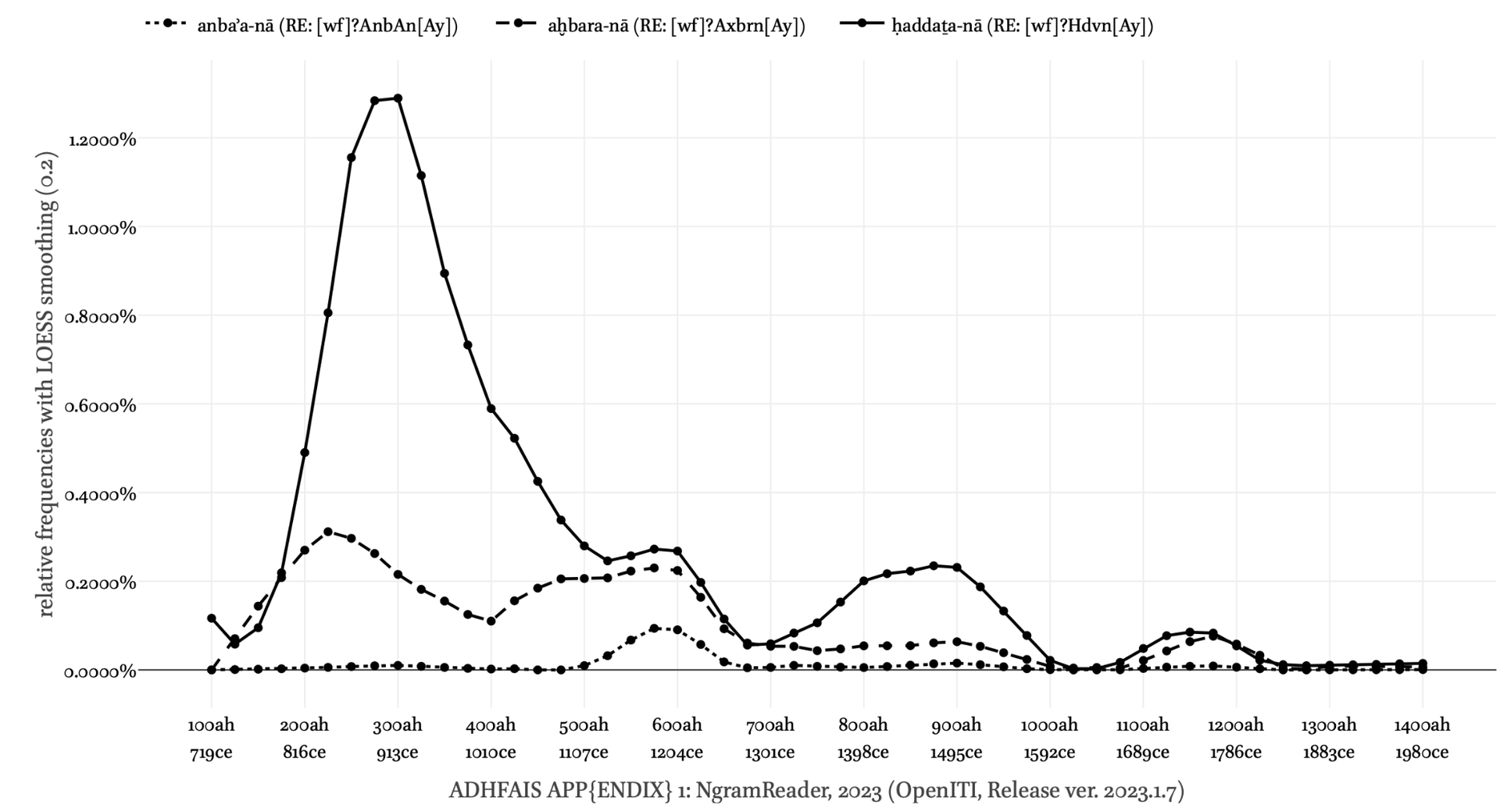
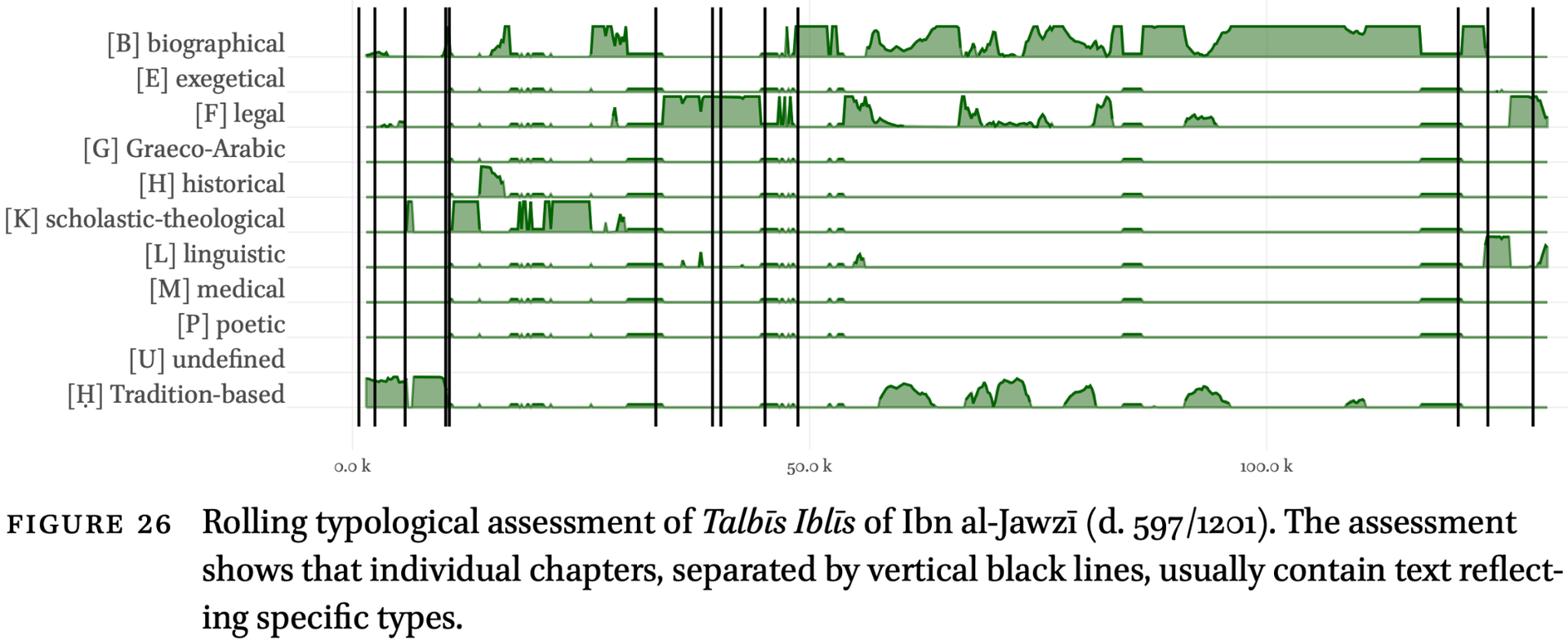
Now that we have a general sense of how the OpenITI NgramReader works, let’s consider a more complex inquiry, this time into terminology central to the study of Ḥadīṯ. In the early 2000s, I made my first attempt at writing a PhD thesis at the Institute of Oriental Manuscripts of the Russian Academy of Sciences in my hometown of St. Petersburg. My dissertation focused on a close reading of “The Devil’s Delusions” (Talbīs Iblīs) by Ibn al-Jawzī (d. 597/1201), the renowned historian, traditionist, and—perhaps most importantly—Ḥanbalī preacher (wāʿiẓ) of Baġdād.
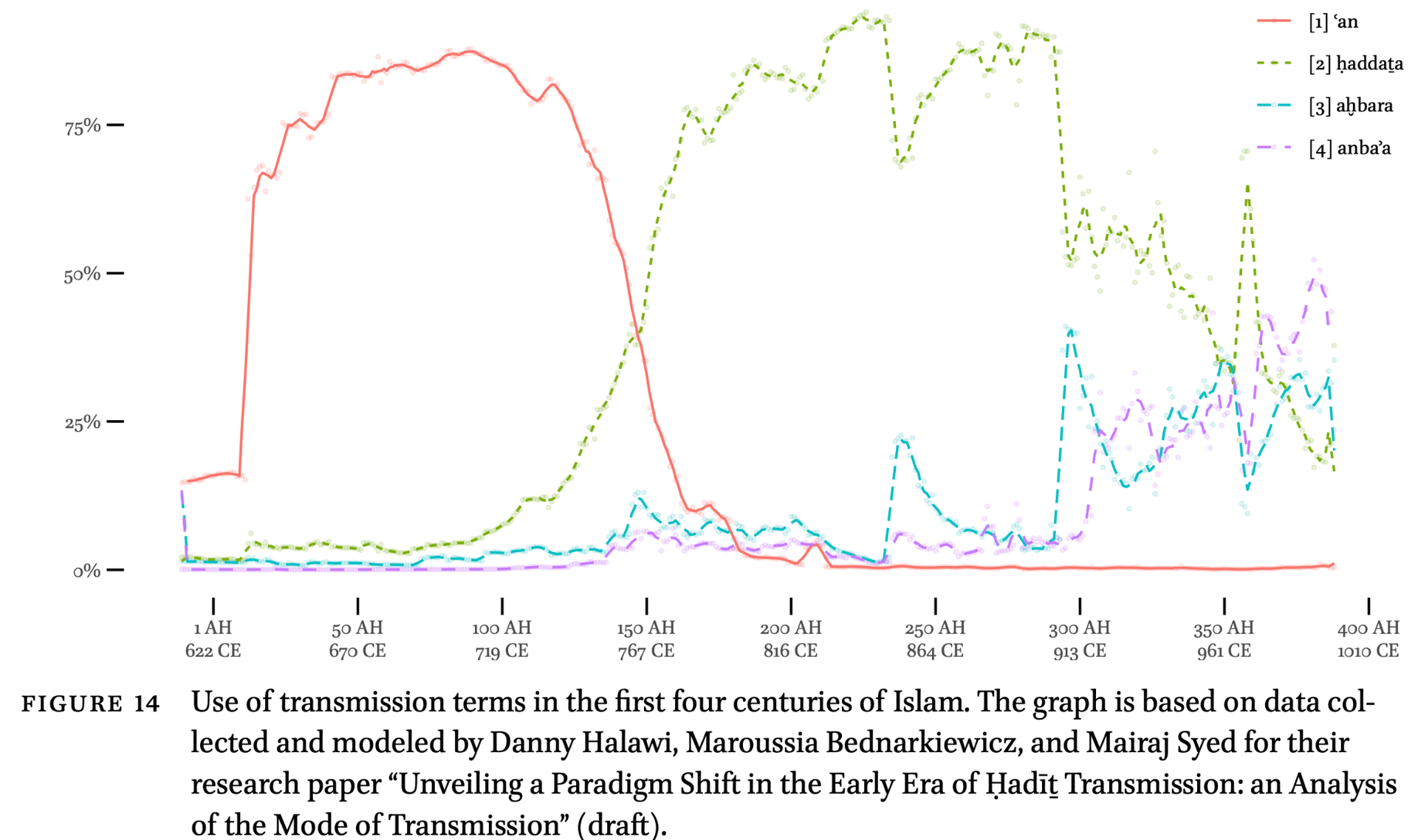
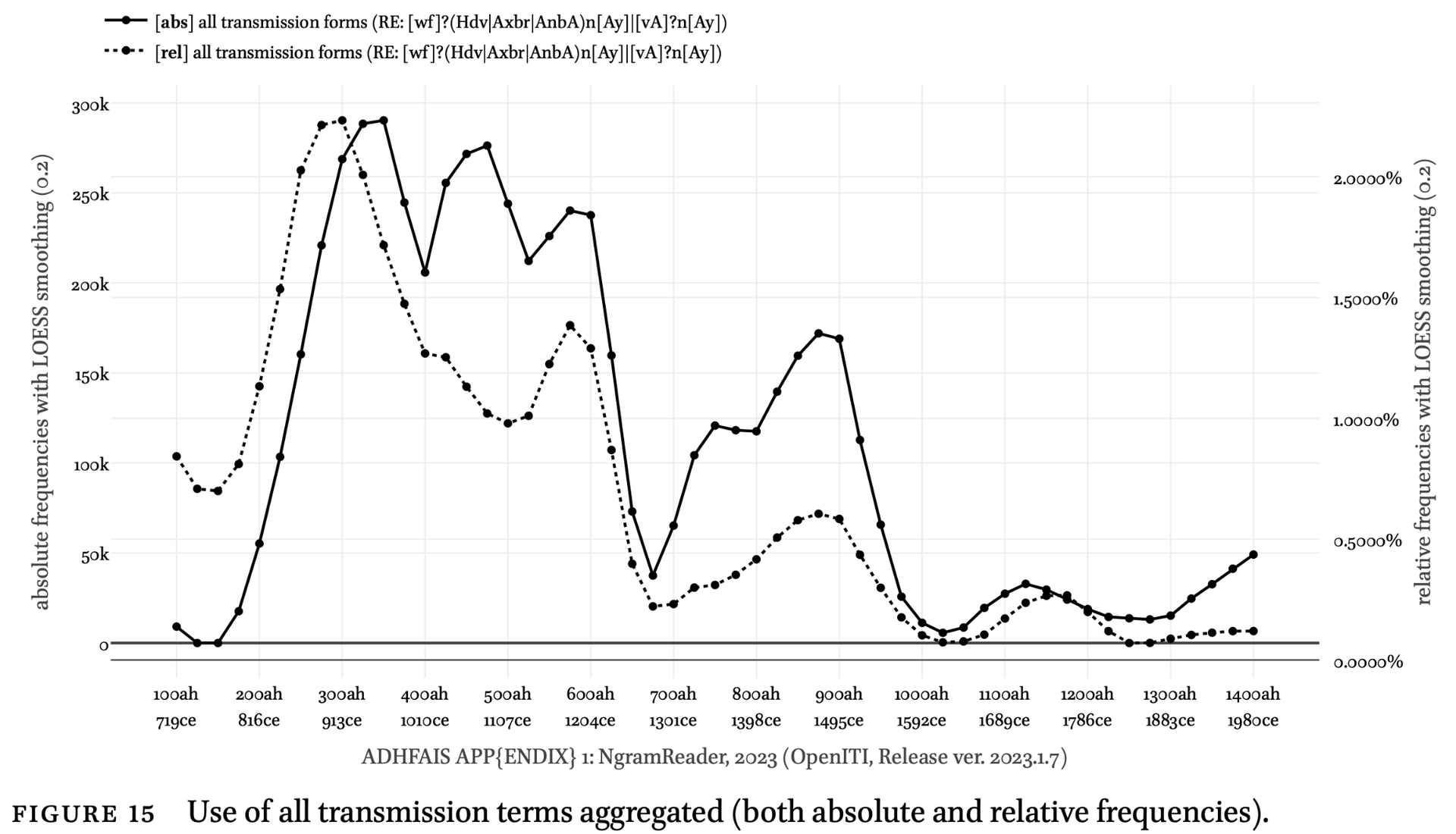
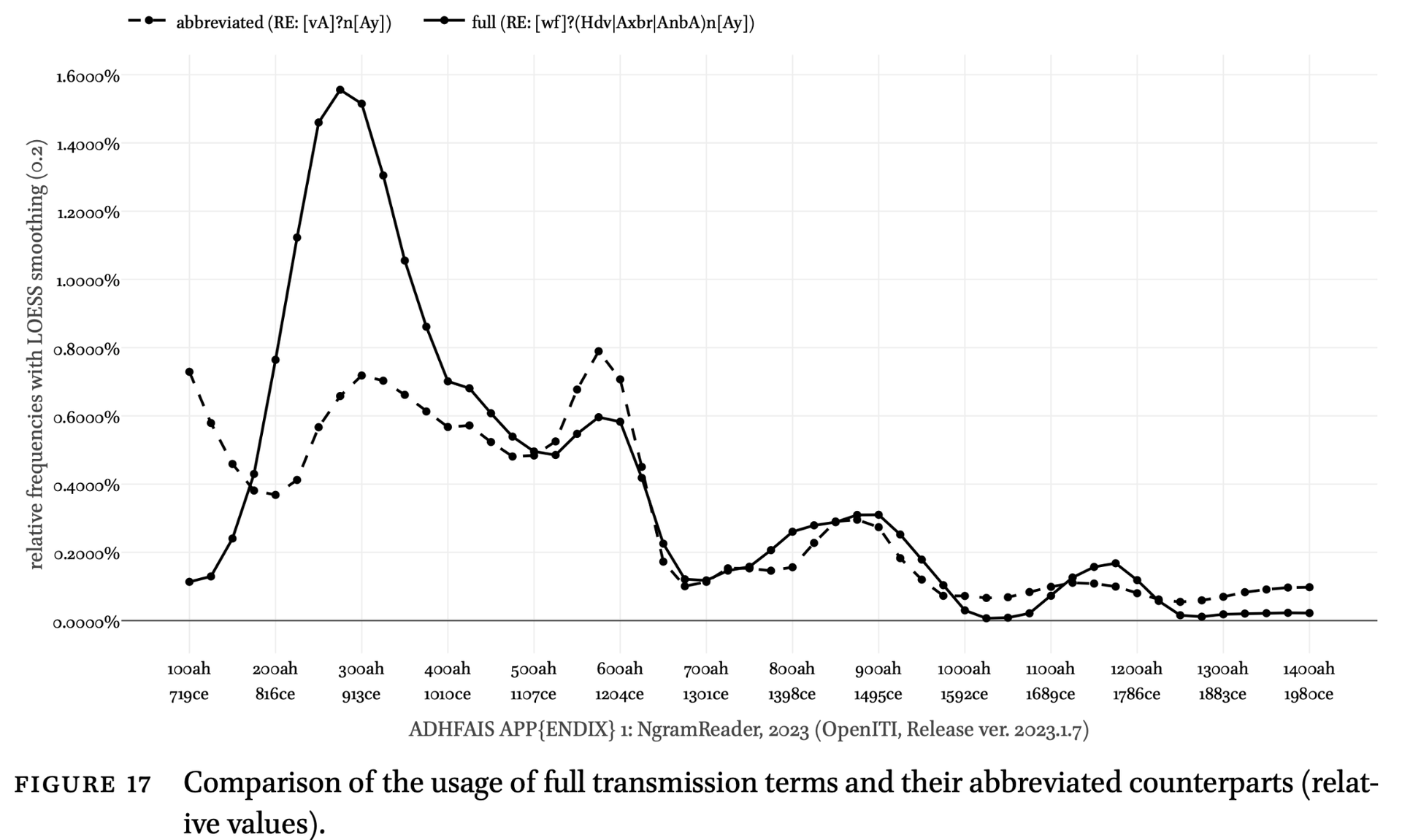
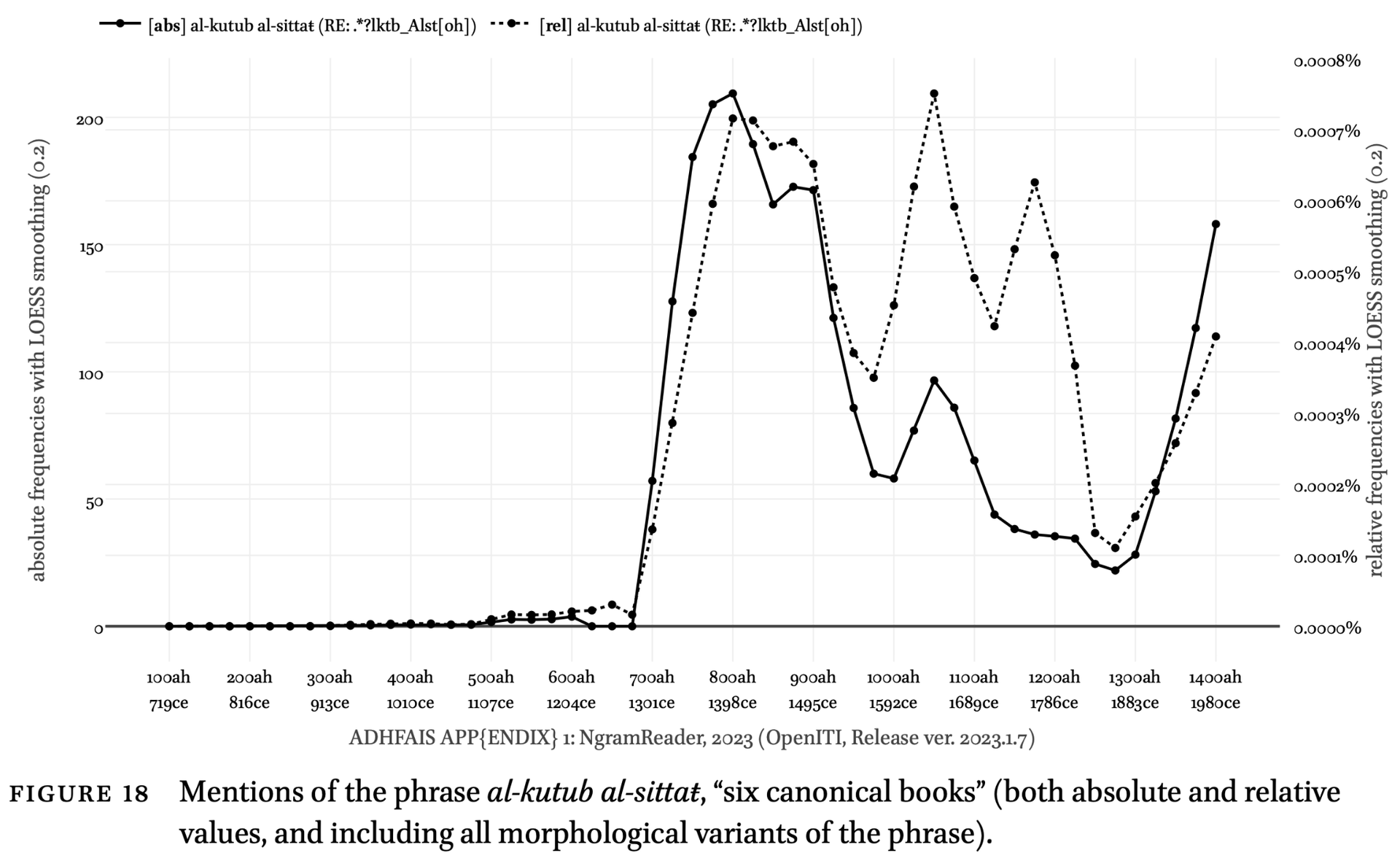
2.2 Proposition 1: The Chronology of Transmission Terms 2.3 Proposition 2: The Decline of Isnāds 2.4 Proposition 3: The Canonization of Ḥadīṯ Collections
ADHFAIS Appendix 1: NgramReader, 2025 (OpenITI, release 2023.1.7). Relative frequencies of anbaʾa-nā, aḫbara-nā, and ḥaddaṯa-nā, with LOESS smoothing.
١Case Study 1: Tracing Term Usage
٢Case Study 2. Modeling Textual Typology
٣Case Study 3. Charting Linguistic Evolution
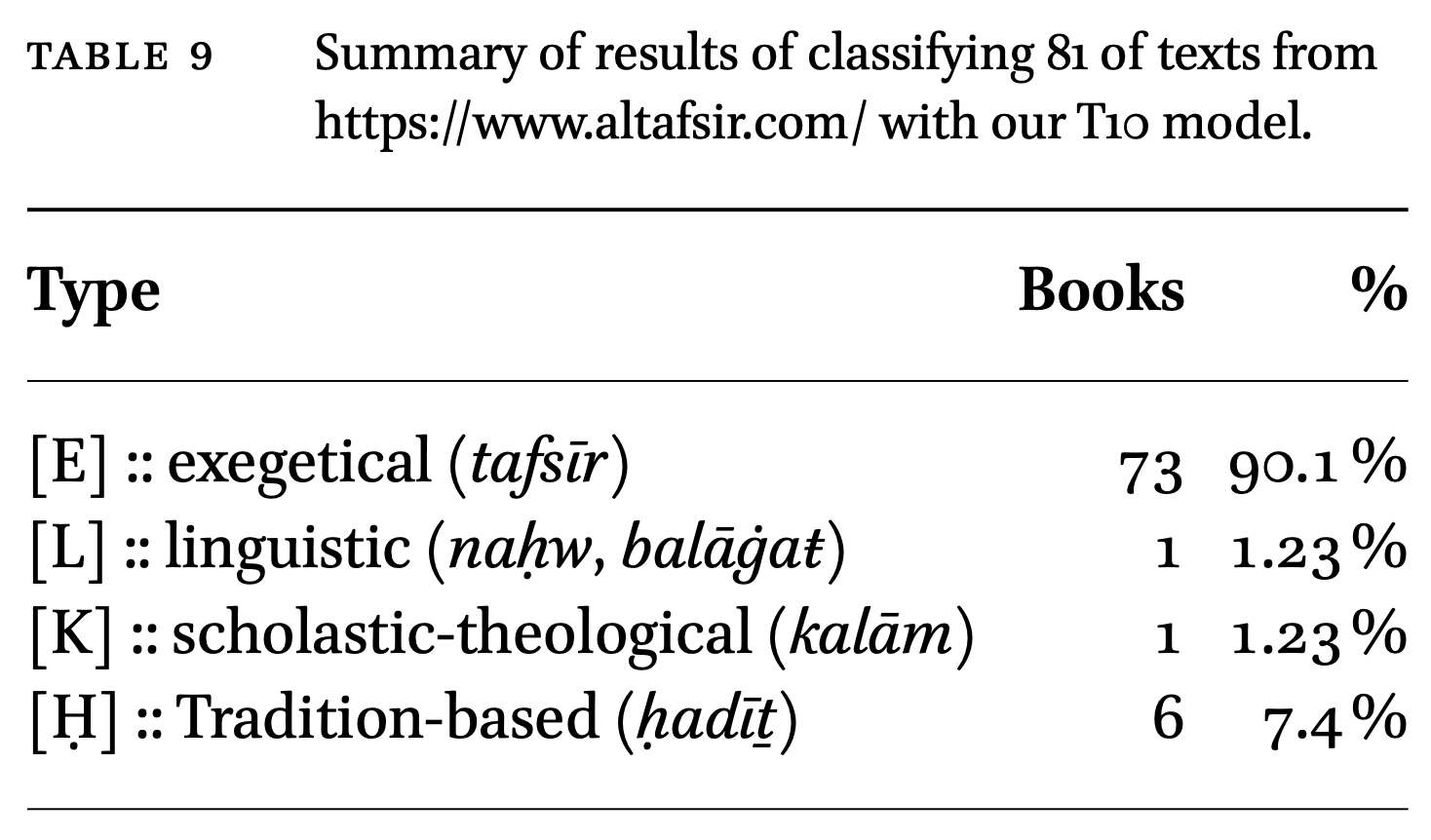
Case Study 2. Modeling Textual Typology
[B] Biographical type (tarājim): mostly collections of biographies
[E] Exegetical type: interpretations of the Qurʾān (tafsīr)
[G] Graeco-Arabic (“Greek-esque”) type (yūnāniyyāt): translations from Greek and works on the development of Greek philosophy in Arabic (falsafat, predominantly Aristotelian)
[H] Historical type (tawārīḫ): mainly chronicles
[F] Legal type (fiqh): a broad variety of legal texts
[L] Linguistic type: a broad variety of grammatical, rhetorical, and lexicographical texts (balāġat, naḥw, maʿājim luġawiyyat)
[M] Medical type (ṭibb): mainly texts on Galenic medicine
[P] Poetic type (šiʿr): mainly collections of poetry (dīwāns)
[K] “Scholastic-theological” type: works of kalām
[Ḥ] Tradition-based type: collections of ḥadīṯ
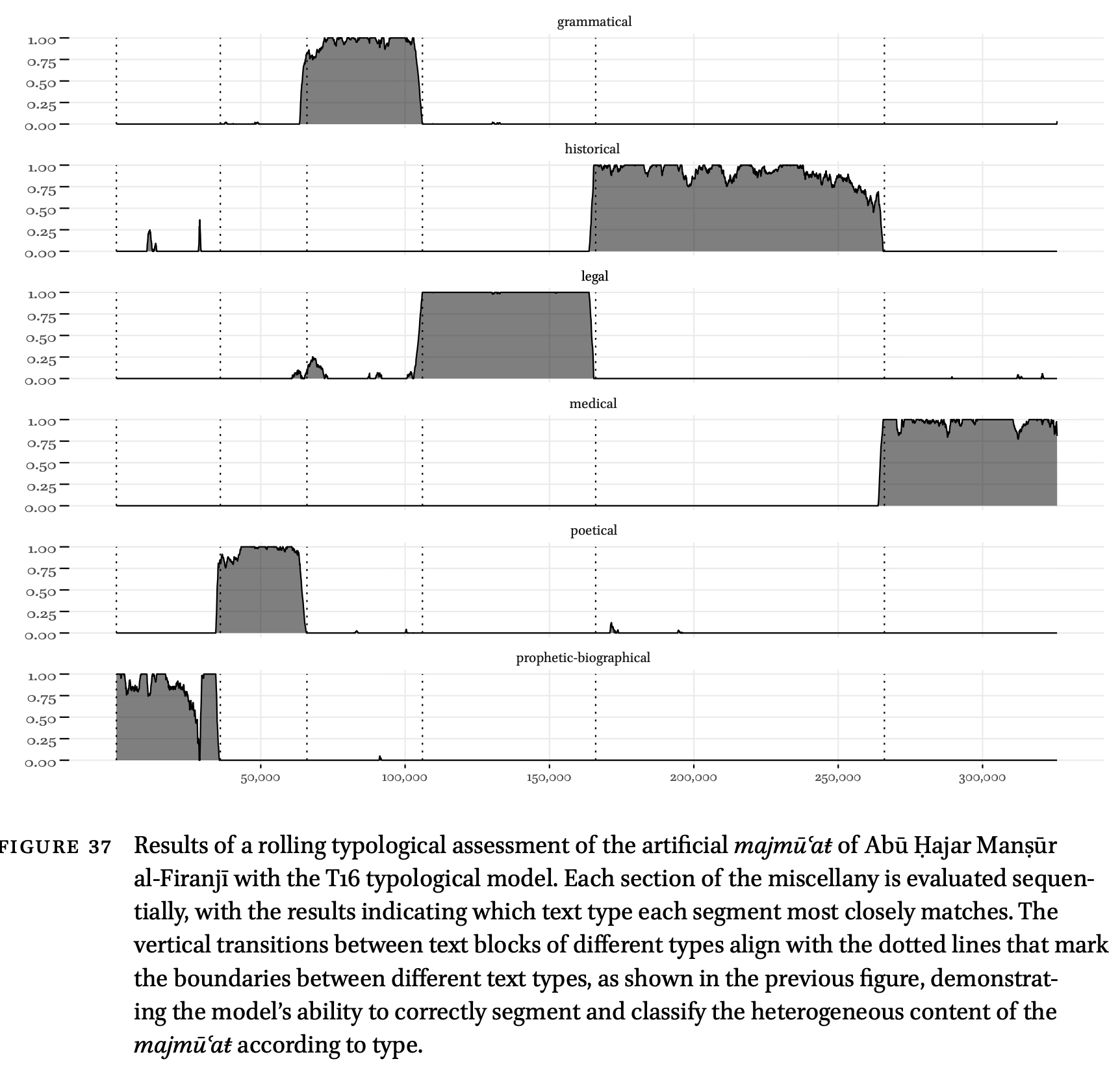
Rolling Typological Assessment
Majmūʿāt Case
١Case Study 1: Tracing Term Usage
٢Case Study 2. Modeling Textual Typology
٣Case Study 3. Charting Linguistic Evolution
Case Study 3. Charting Linguistic Evolution
The pre-classical period lasts from the appearance of Islam until the end of the Umayyad period (c. 1–132/622–750).
The classical period corresponds roughly to the ʿAbbāsid period (132–656/750–1258).
The postclassical period encompasses the reign of the Mamlūks (648–923/1250–1517) and most of that of the Ottomans.
The modern period (from Napoleon’s invasion of Egypt in 1213/1798), extending to the present day.
Case Study 3. Charting Linguistic Evolution
Preclassical c. 622–750
Classical 750–1258
Postclassical 1258–1798
Modern 1798–
Preclassical600–750
Classical750–1258
Postclassical1258–1798
Modern1798–
Where do these lines come from?
Geschichte der arabischen Litteratur, 5 vols. (1896–1943)
Cambridge History of Arabic Literature, 6 vols. (1983–2006)
Encyclopedia of Arabic Language and Linguistics (Brill)
A model the field built impressionistically
Periodization is unavoidable: It organizes research, explanation, teaching. It is a major historian’s tool.
But the architecture of the standard scheme was never systematically derived from the written tradition as a whole.
What if we ask the written tradition itself?
The obvious casualty: the Mamluk centuries
c. 1250–1517: one of the busiest periods of Arabic textual production
Yet usually absorbed into a vast “postclassical” period, often called the “Period of Decadence”
The category hides distinctiveness instead of explaining it
Does the corpus itself see a coherent middle period?
Two witnesses
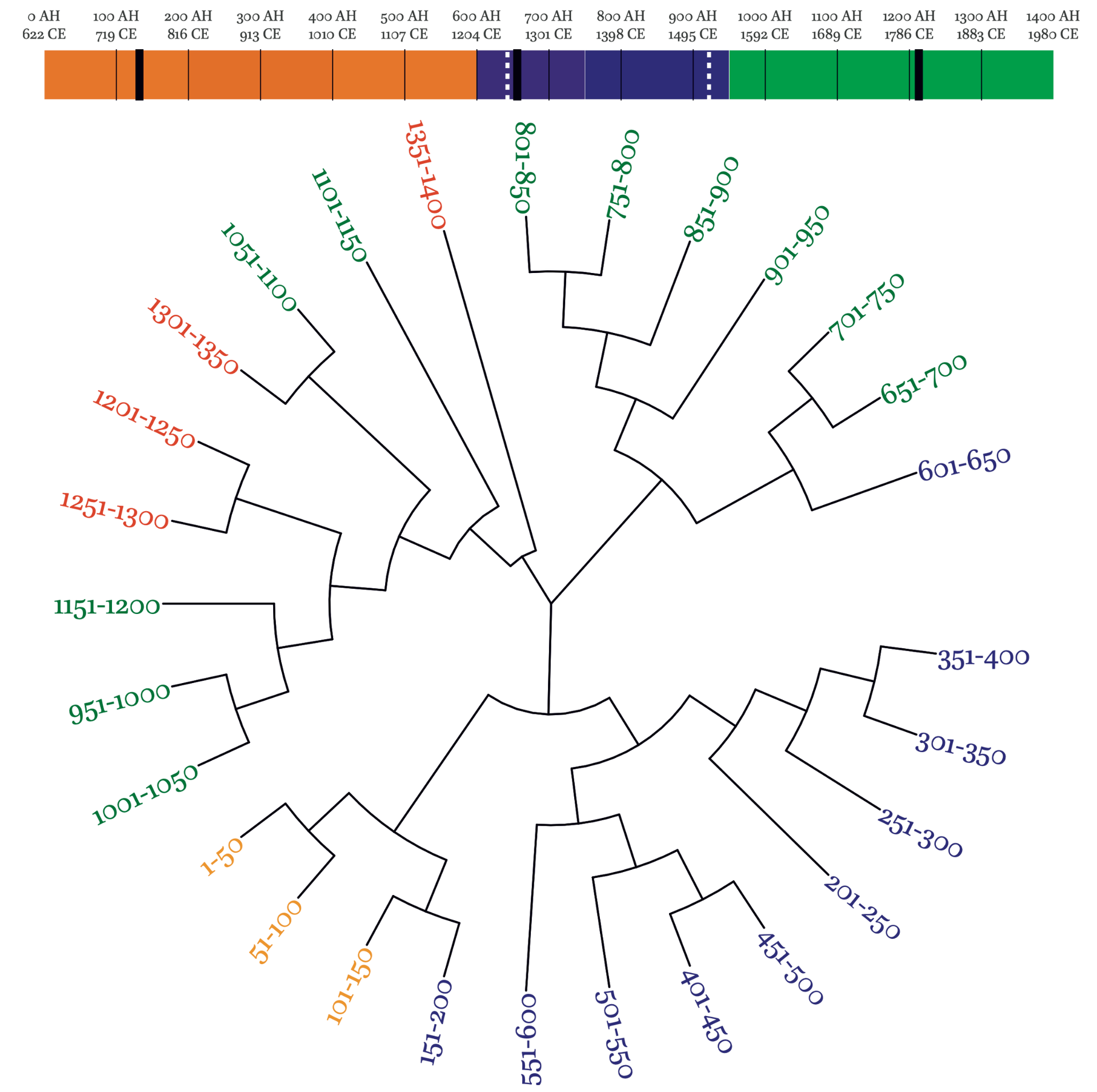
First witness: Corpus
Two lenses on change
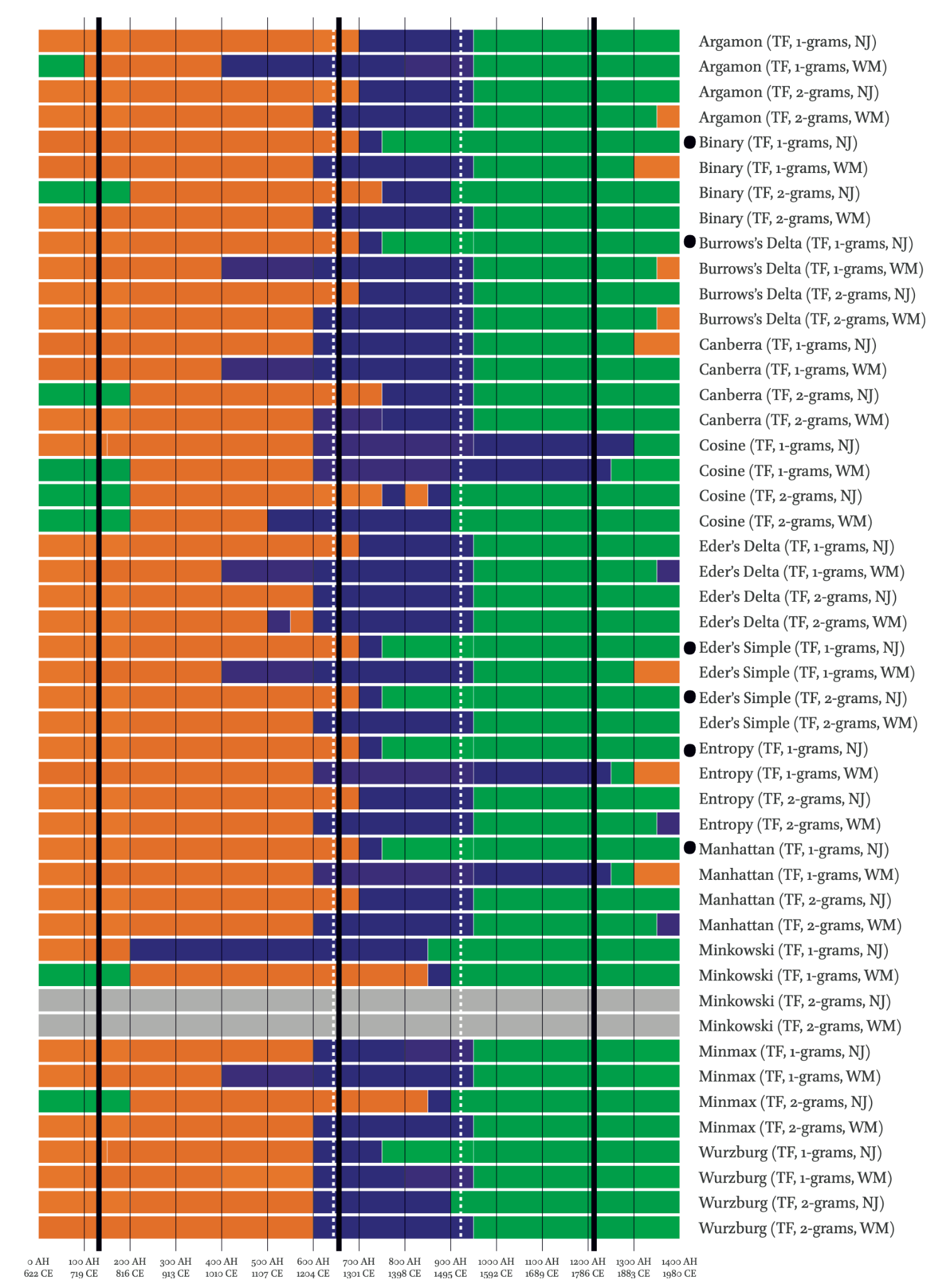
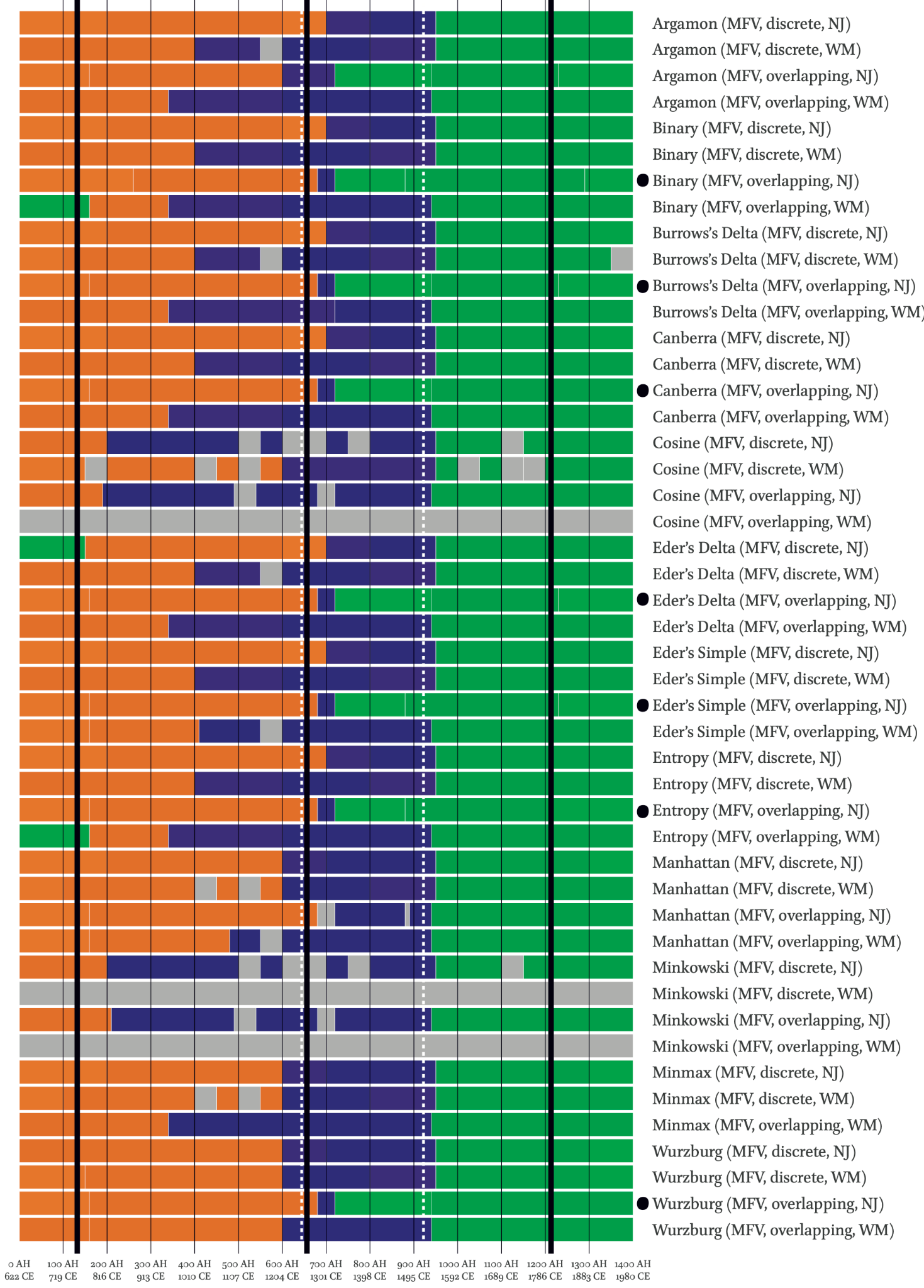
Keywords (TF–IDF): what texts are about Style (MFV): how texts are written
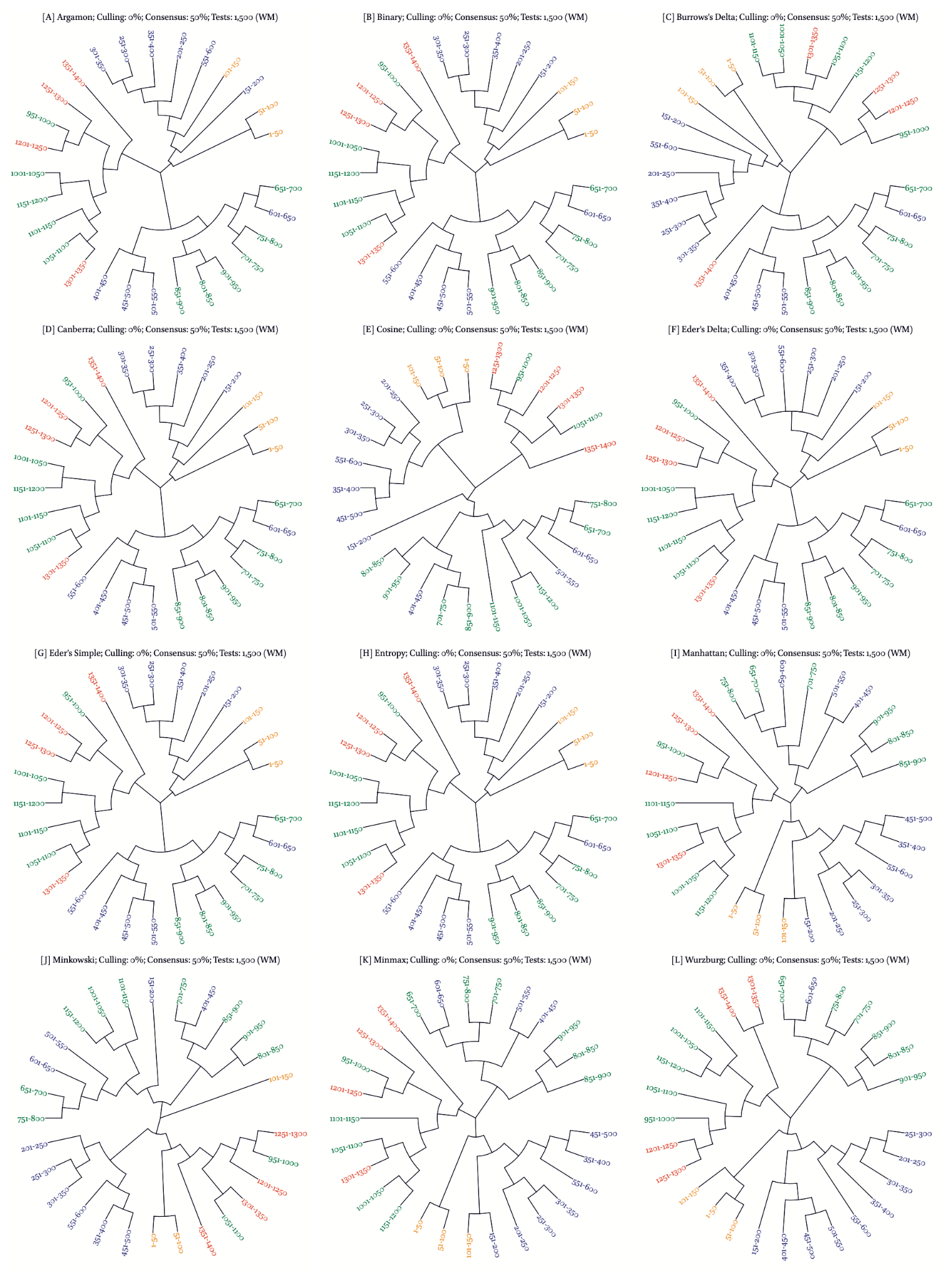
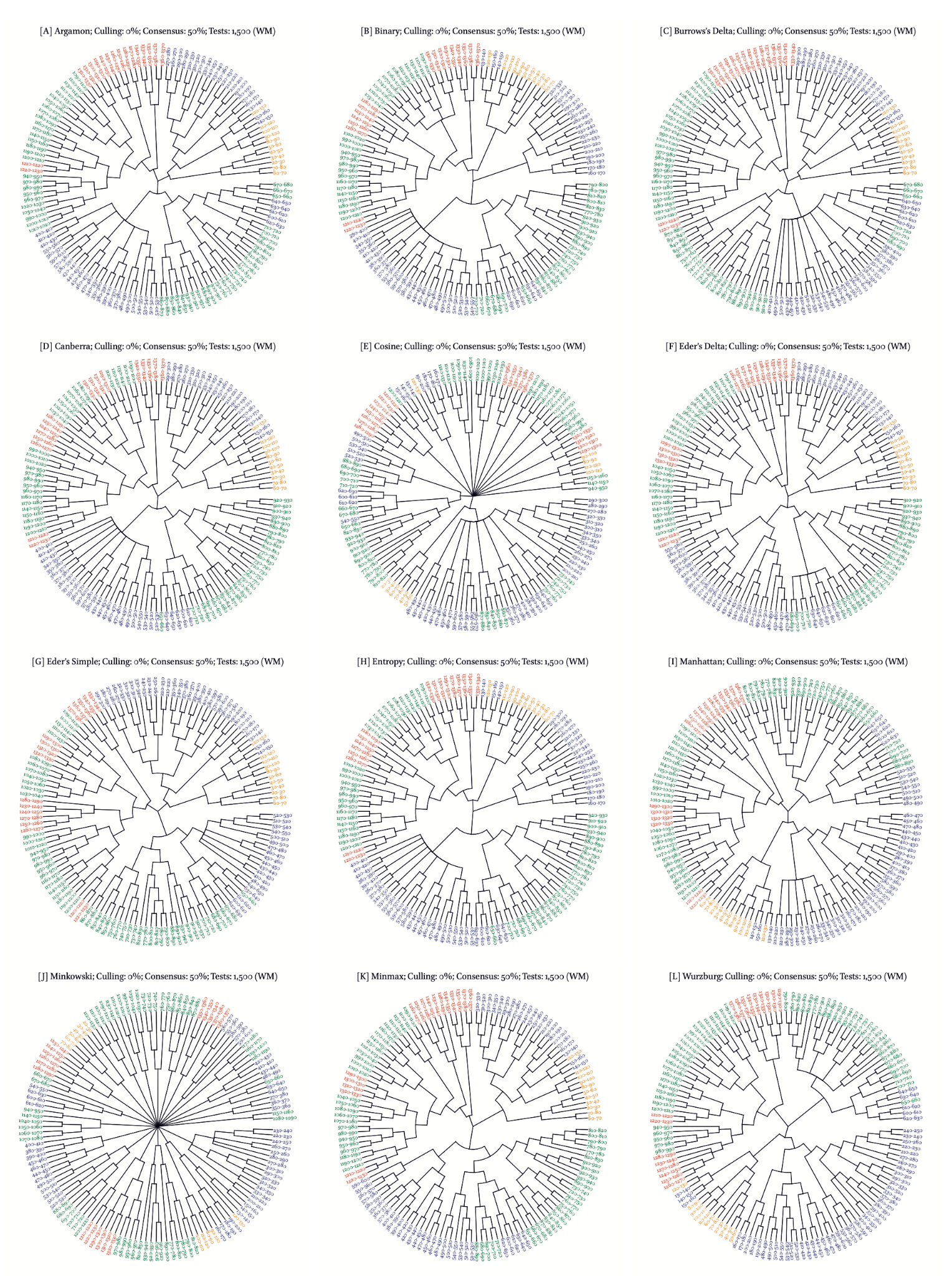
Hundreds of parameter combinations
3,000 random samples (MFV)
72,000 dendrograms » 48 consensus trees
Do not trust a tree. Ask what survives across trees.
Contentkeywords / TF–IDF
Stylemost frequent vocabulary
Style
stylometry
distributions of frequencies of most frequent words (function words) are unique to individual:
authors
periods
Style
stylometry
distributions of frequencies of most frequent words (function words) are unique to individual:
Stylometric profiles often attach it to the early macroperiod
The language evolves slower than the written tradition: new distinct themes, but older language
Two clocks: themes shift faster than language.
A different macrohistory of the written tradition
Early: c. 622–1200
Middle: c. 1200–1540
Late: c. 1540–1980
Boundaries are transition zones, not event dates
Earlyc. 622–1200
Middlec. 1200–1540
Latec. 1540–1980
Two witnesses
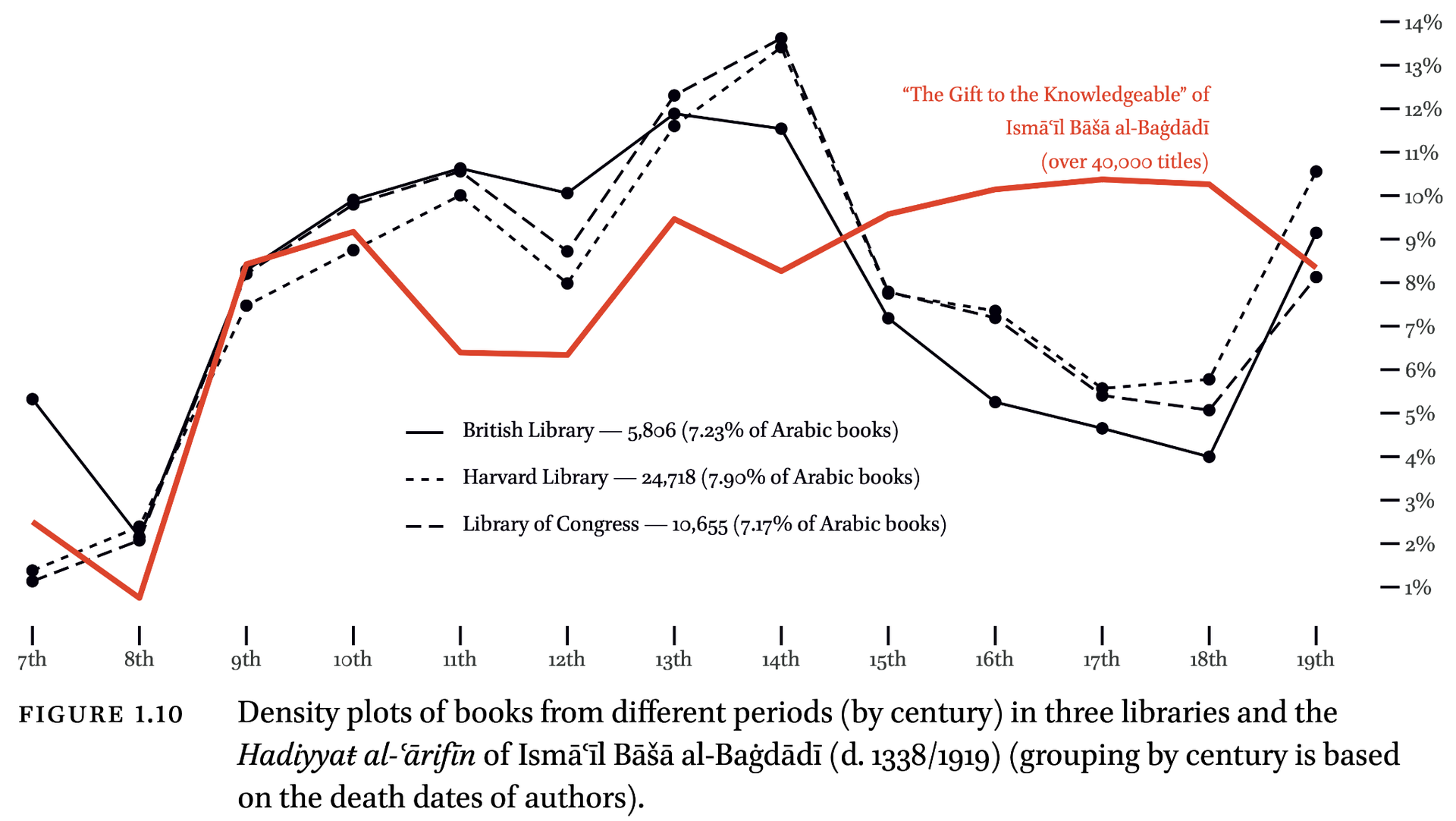
Second witness: Bio-Bibliographical Collection
Second witness: 8,800 authors
Ismāʿīl Bāšā al-Baġdādī (d. 1338/1919)
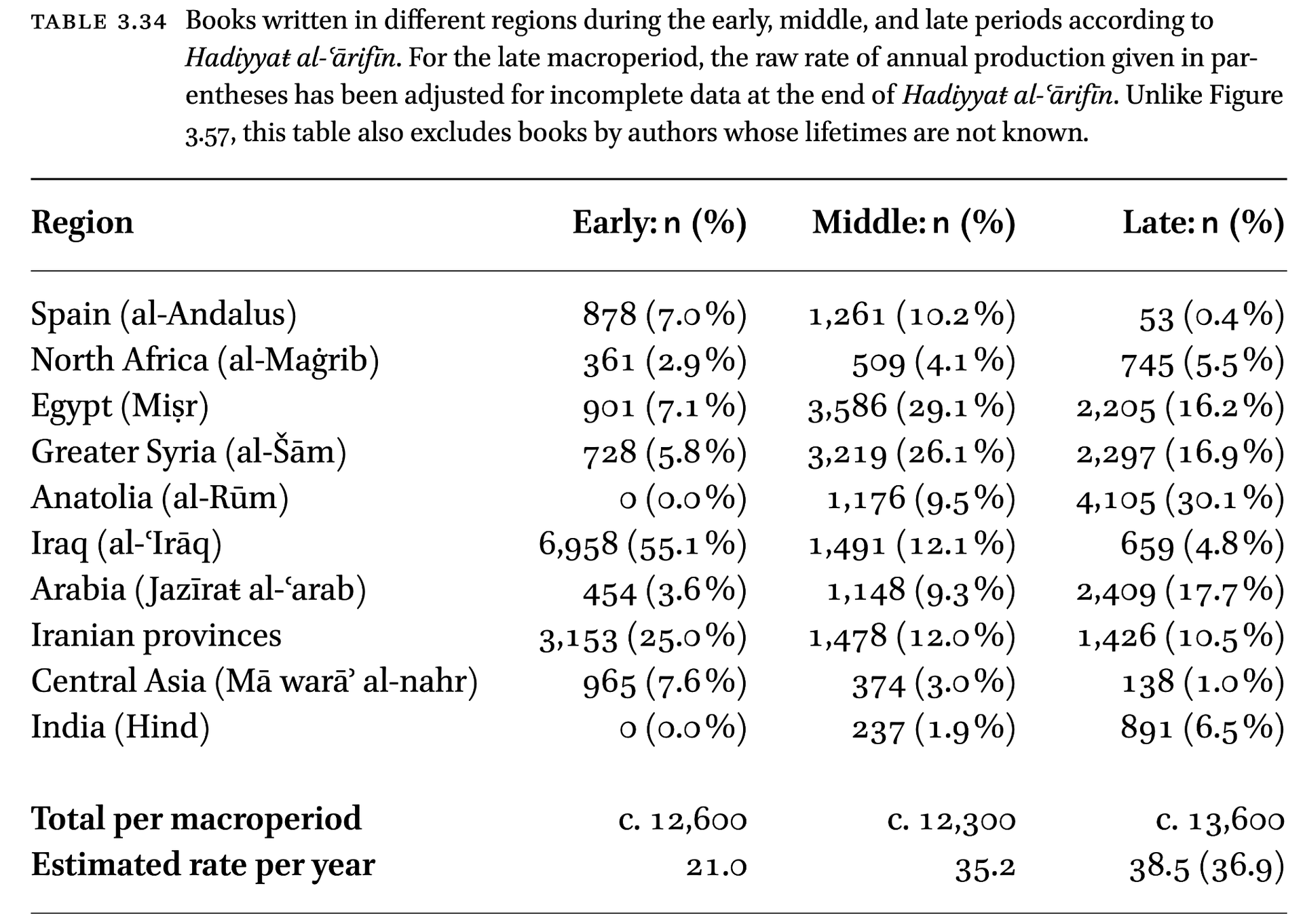
Hadiyyat al-ʿārifīn c. 8,800 authors; 40,000+ titles A bio-bibliographical model of the tradition
Independent of the corpus experiments
8,800authors
40,000+titles
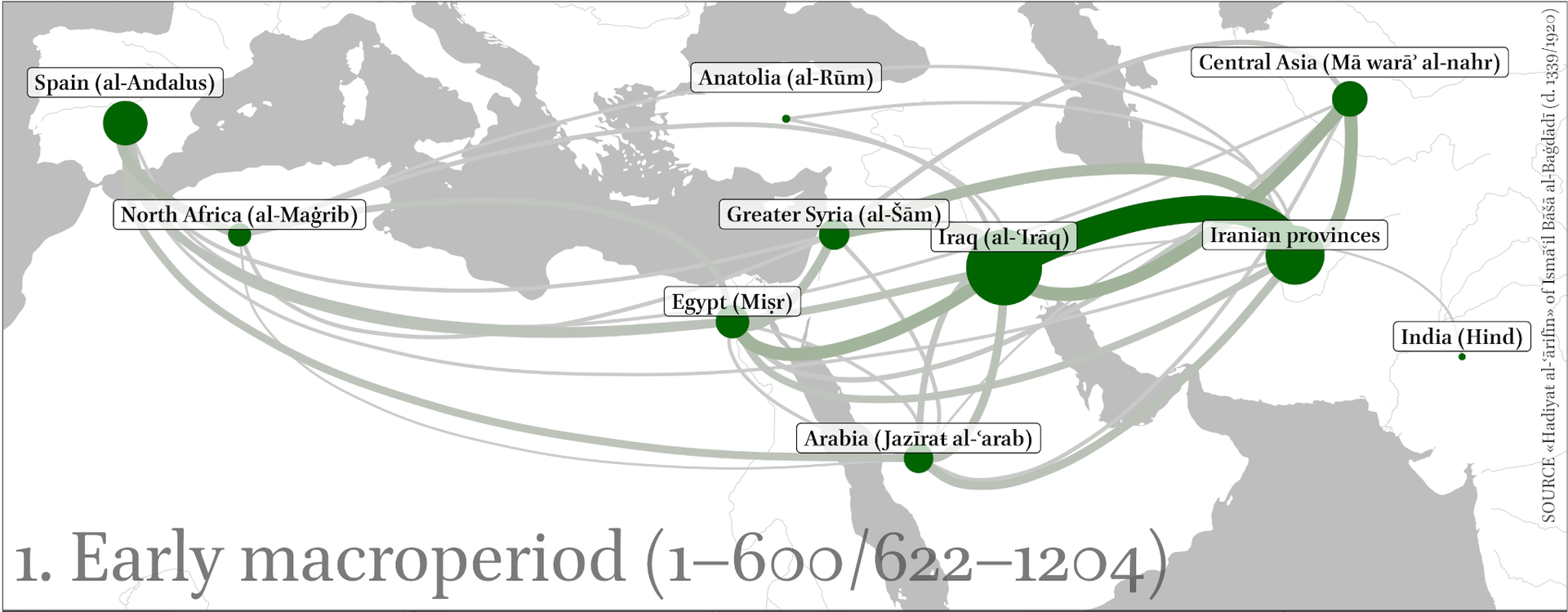
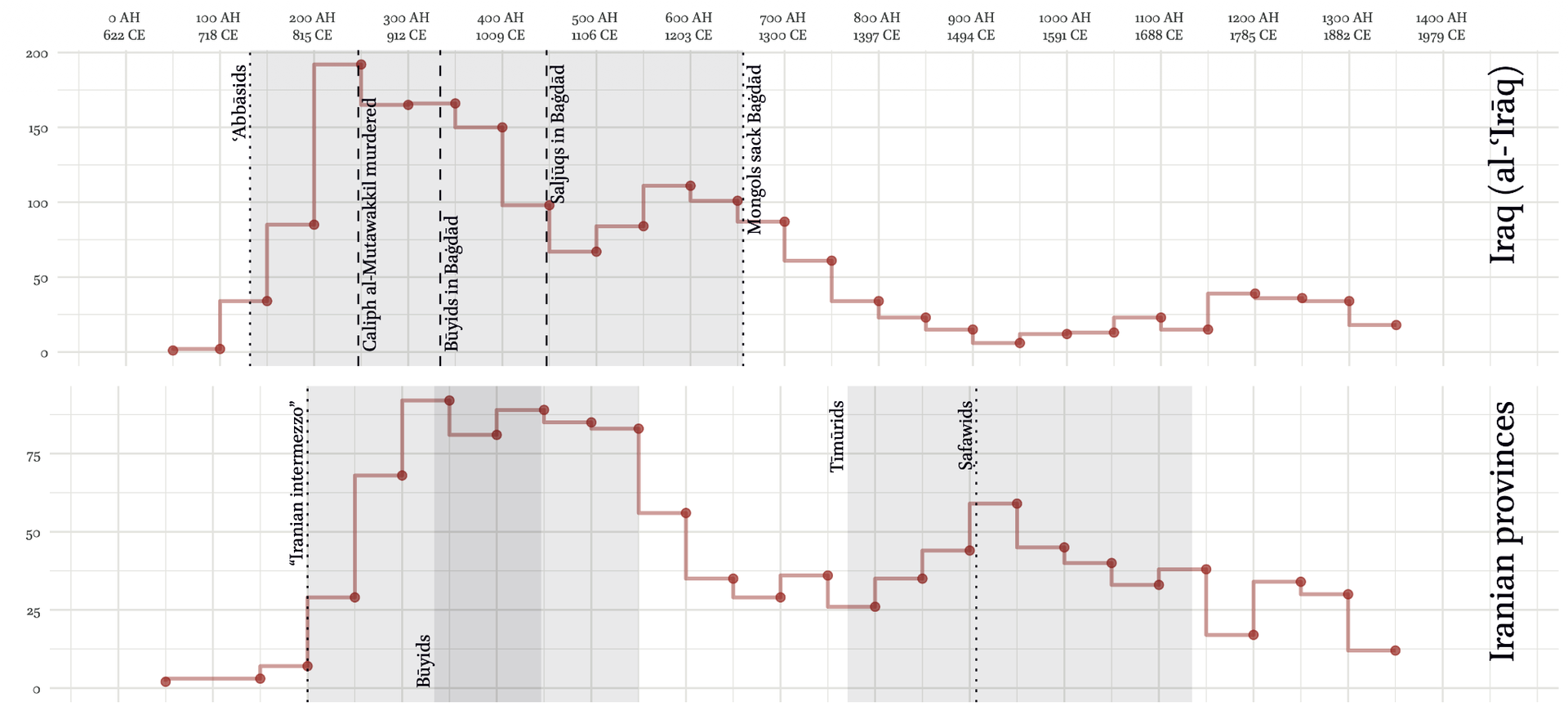
c. 600–1200: an Iraqi-Iranian world
> 80% Iraq + Iran
c. 600–1200: an Iraqi-Iranian world
> 80% Iraq + Iran
Annual production by region in the early macroperiod: Iraq (al-ʿIrāq) and the Iranian provinces.
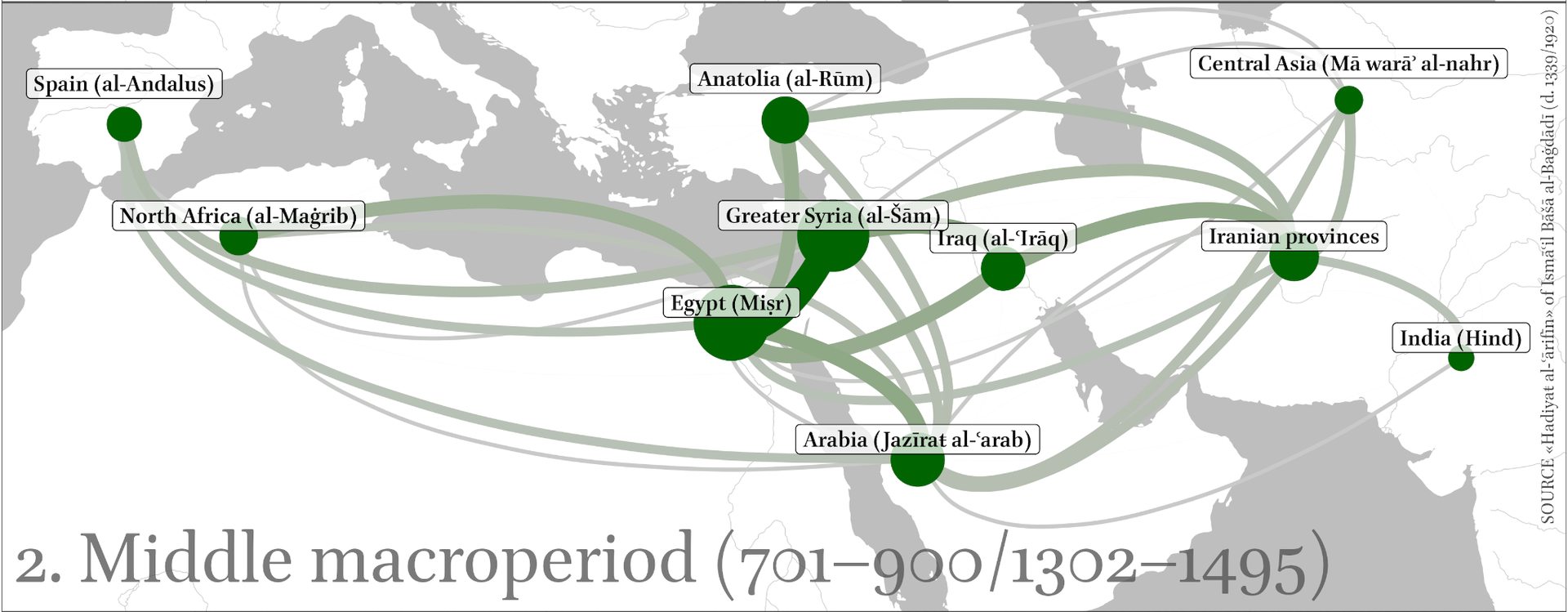
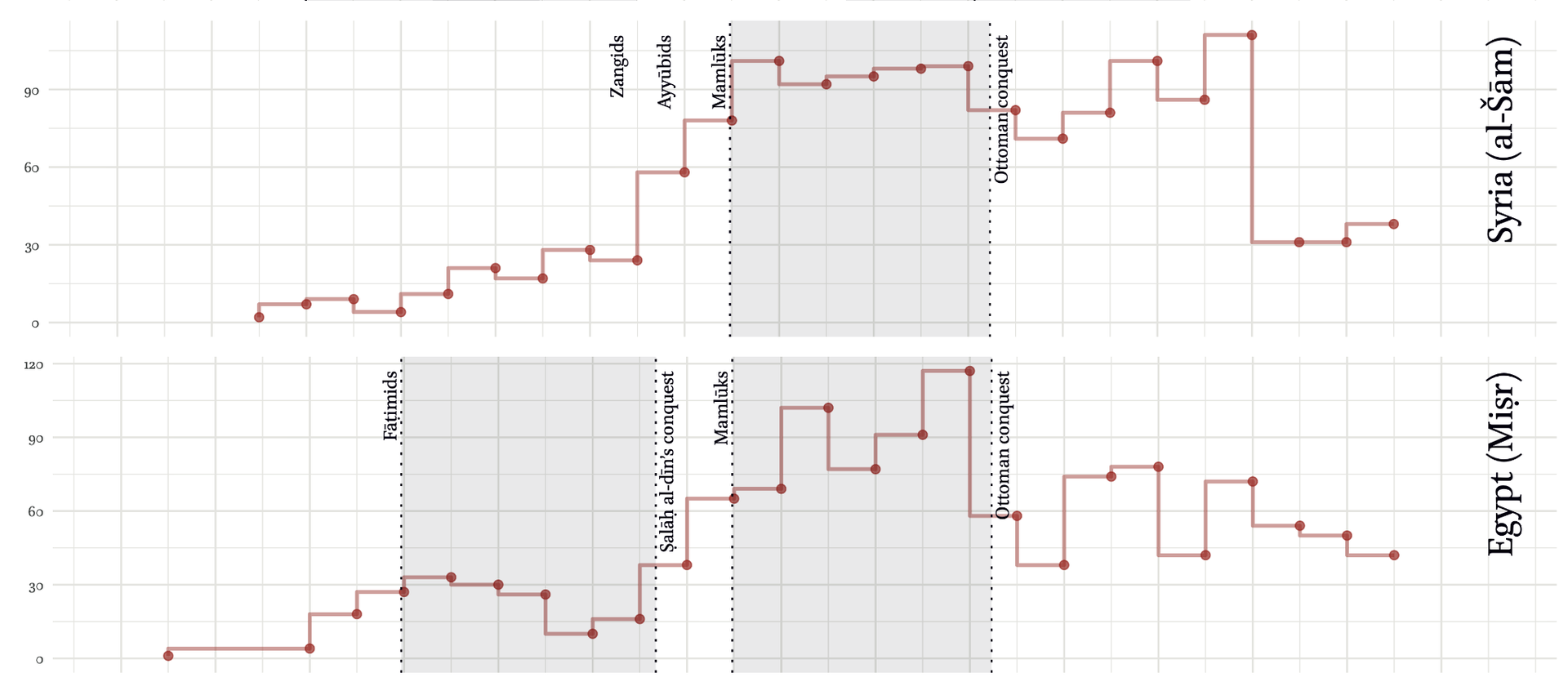
c. 1200–1540: a Syrian-Egyptian world
> 55% Egypt + Syria
c. 1200–1540: a Syrian-Egyptian world
> 55% Egypt + Syria
Annual production by region in the middle macroperiod: Syria (al-Šām) and Egypt (Miṣr).
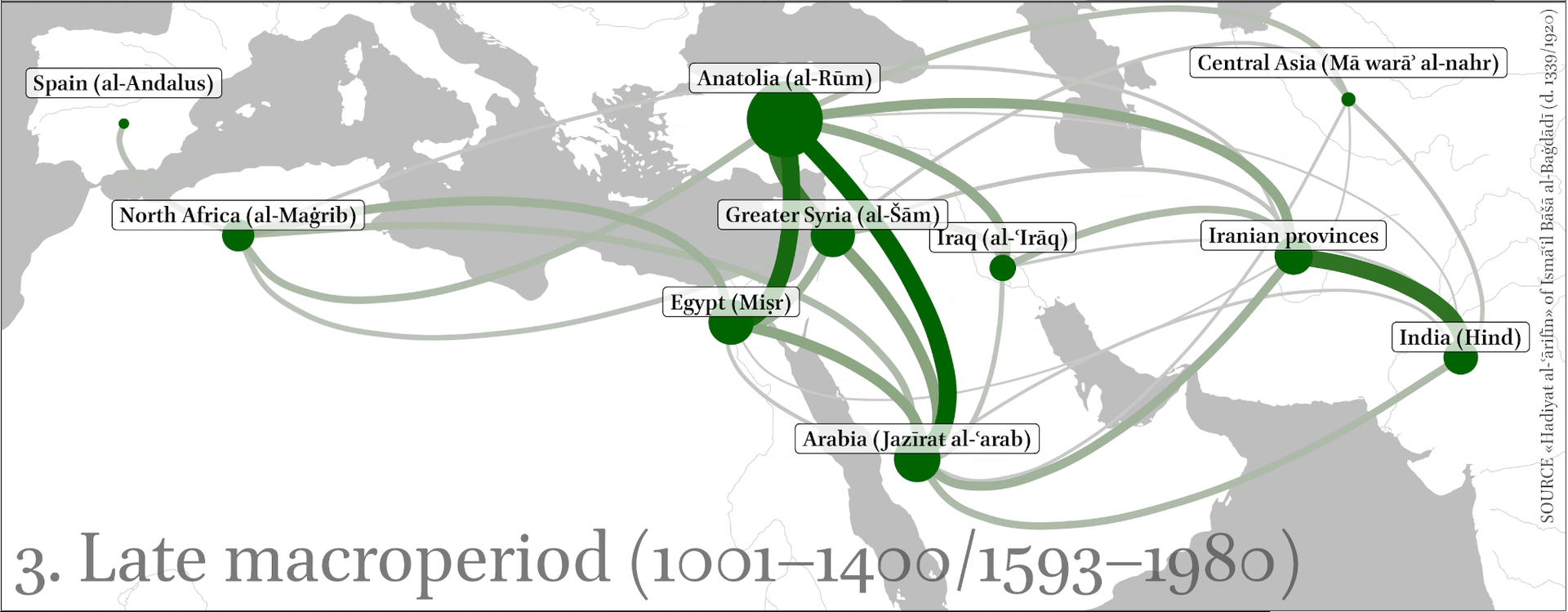
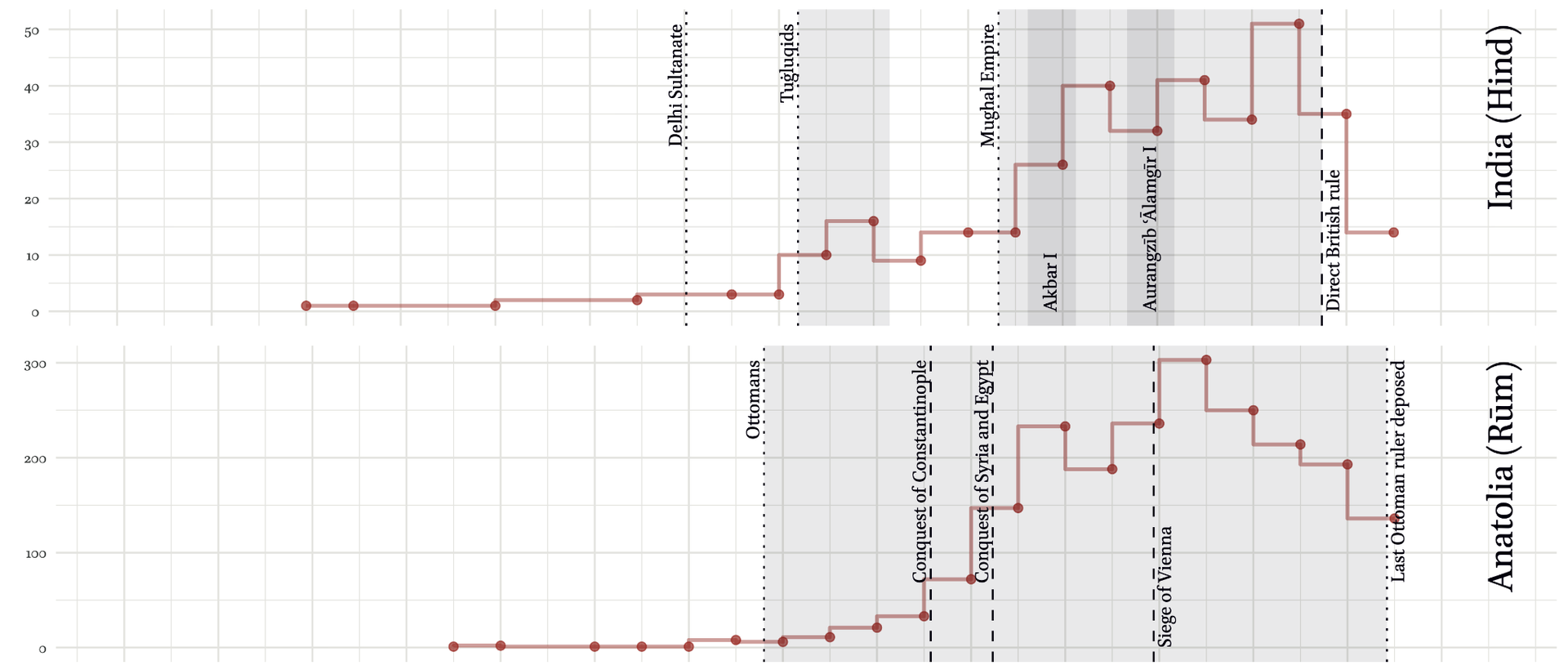
After c. 1540–1900: a new polycentric geography
≈ 30% Anatolia
After c. 1540–1900: a new polycentric geography
≈ 30% Anatolia
Annual production by region in the late macroperiod: India (Hind) and Anatolia (al-Rūm).
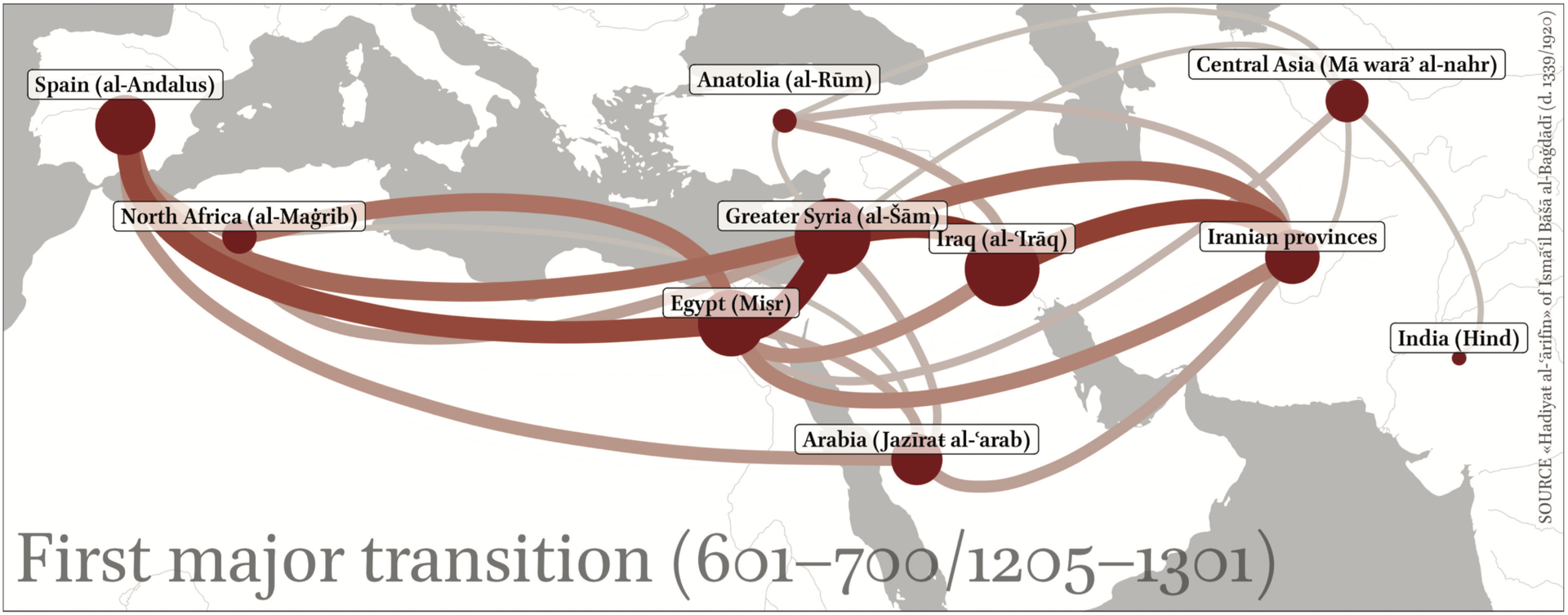
Two transitions: 1200–1300 and 1500–1600
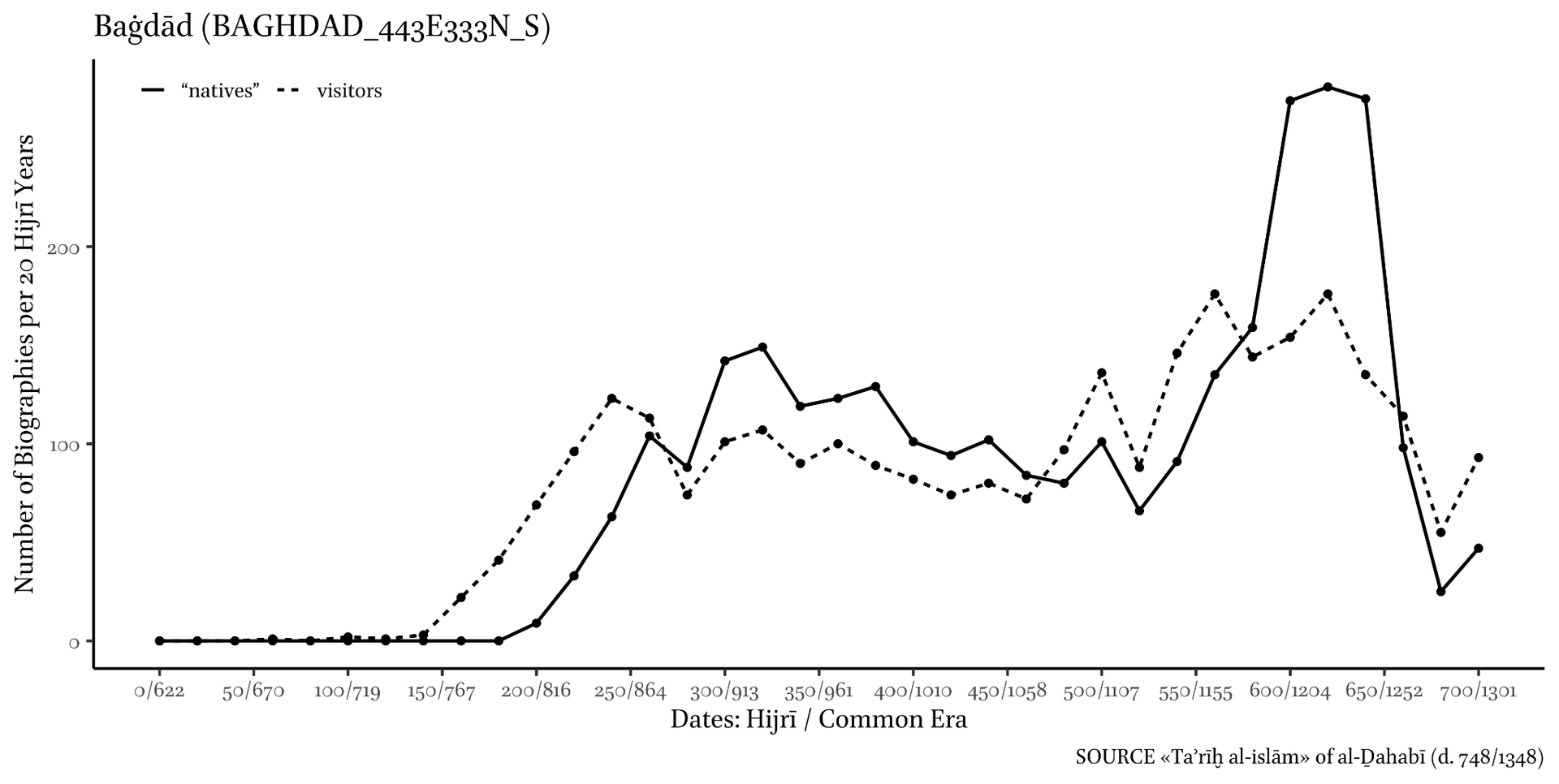
Westward movement from Iraq and Iran begins before the Mongol conquest
Andalusi scholars move east as Christian expansion advances in Iberia
Baghdad’s fall occurs inside an already-moving geography
Patterns: Great Cities of Islam
Two transitions: 1200–1300 and 1500–1600
Two transitions: 1200–1300 and 1500–1600
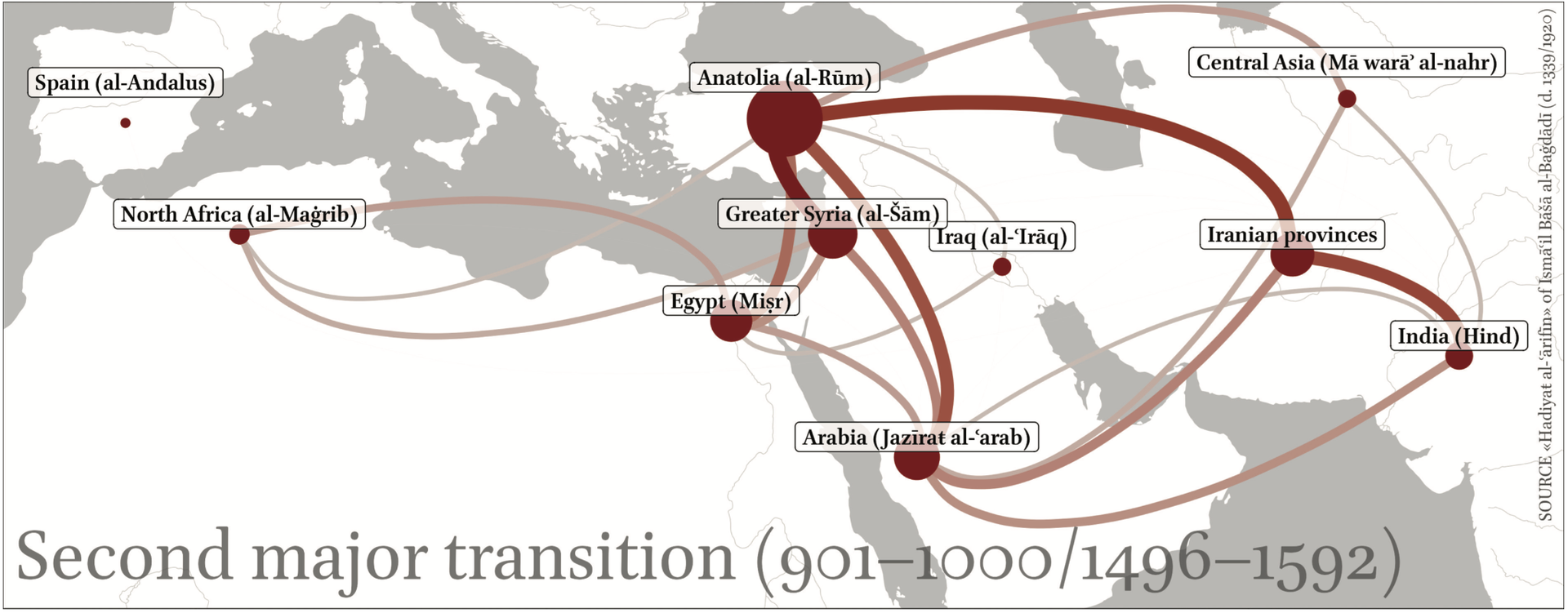
The rise of the Ottoman Empire marks the emergence of a Turco-Arabic world under Ottoman control
and the parallel development of an Indo-Iranian sphere.
Two transitions: 1200–1300 and 1500–1600
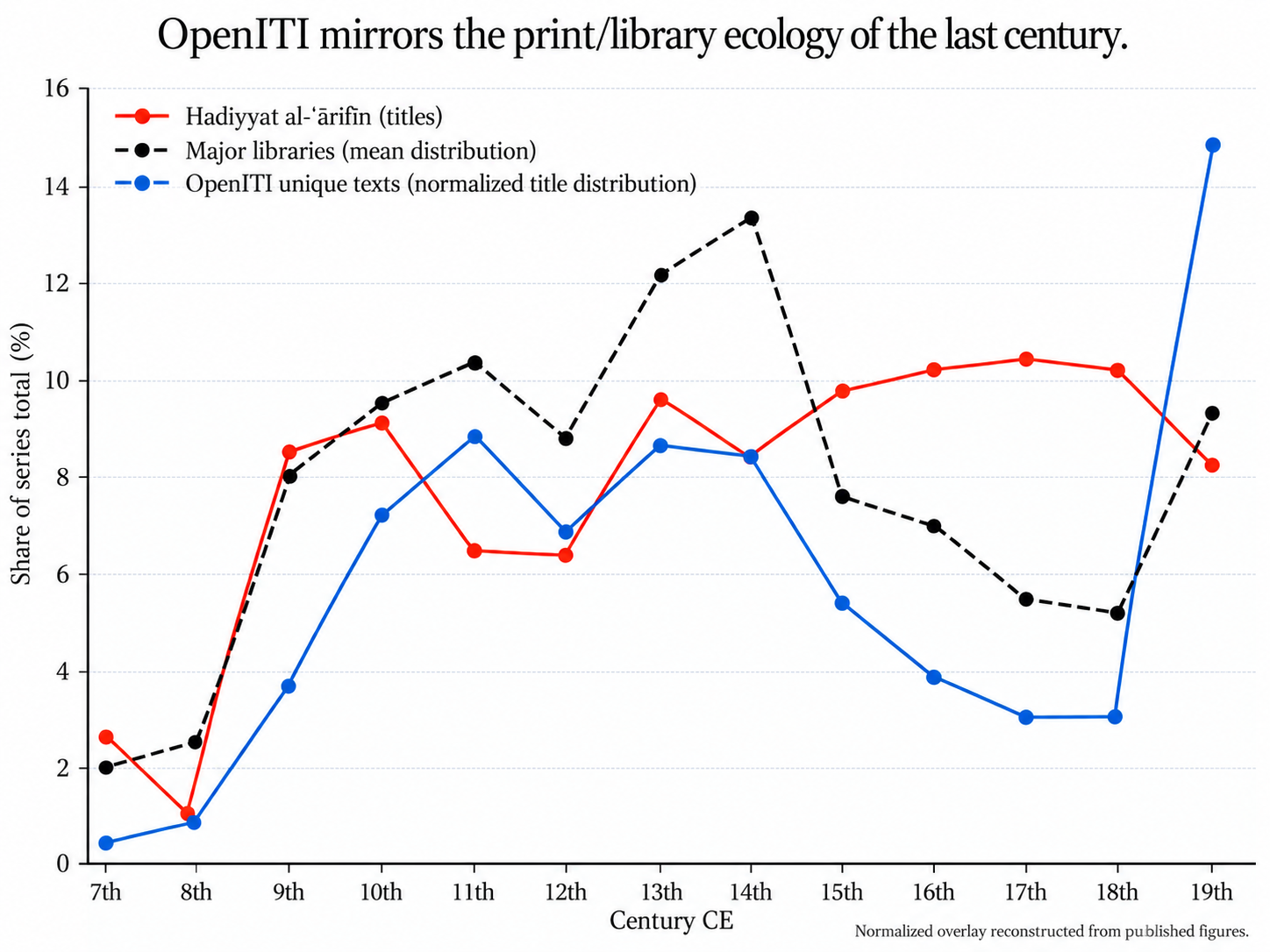
Two independent witnesses
CORPUS of TEXTS lexical/thematic and stylometric change
REGISTER of AUTHORS cultural geography over time
Different biases. Different assumptions. Similar macro-boundaries.
Three long cultural regimes (macroperiods)
The early Iraqi-Iranian · c. 622–1200
The middle Syrian-Egyptian · c. 1200–1540
The late Turco-Indian · c. 1540–1980
(with discernable sub-periods inside each)
Periods are also places
Traditional periodization assumes universality
Computational periodization demonstrates that language and textual production are aligned in time with changing cultural geography *
Each period gets not just a name, but also a map.
(* to be redone on the EIS1600 data: 600,000 bios > c. 130,000 individuals)
What changes if we accept this model?
The Mamluk centuries become a coherent middle period, not the beginning of decline
1258 is recontextualized as an event within a longer transition (1200–1300)
c. 1540 emerges as a major structural break (essentially, the end of the Mamluk period)
Chronology & geography become part of the same explanation
Afterword: farḍ al-kifāyaŧ
A communal duty in Islamic law: if enough members of a community fulfill it, the rest are absolved. If all neglect it, the entire community is accountable.
No one else will digitize our texts.
No one will create our corpora.
No one will develop methods for our research questions.
This is our responsibility, and ours alone.
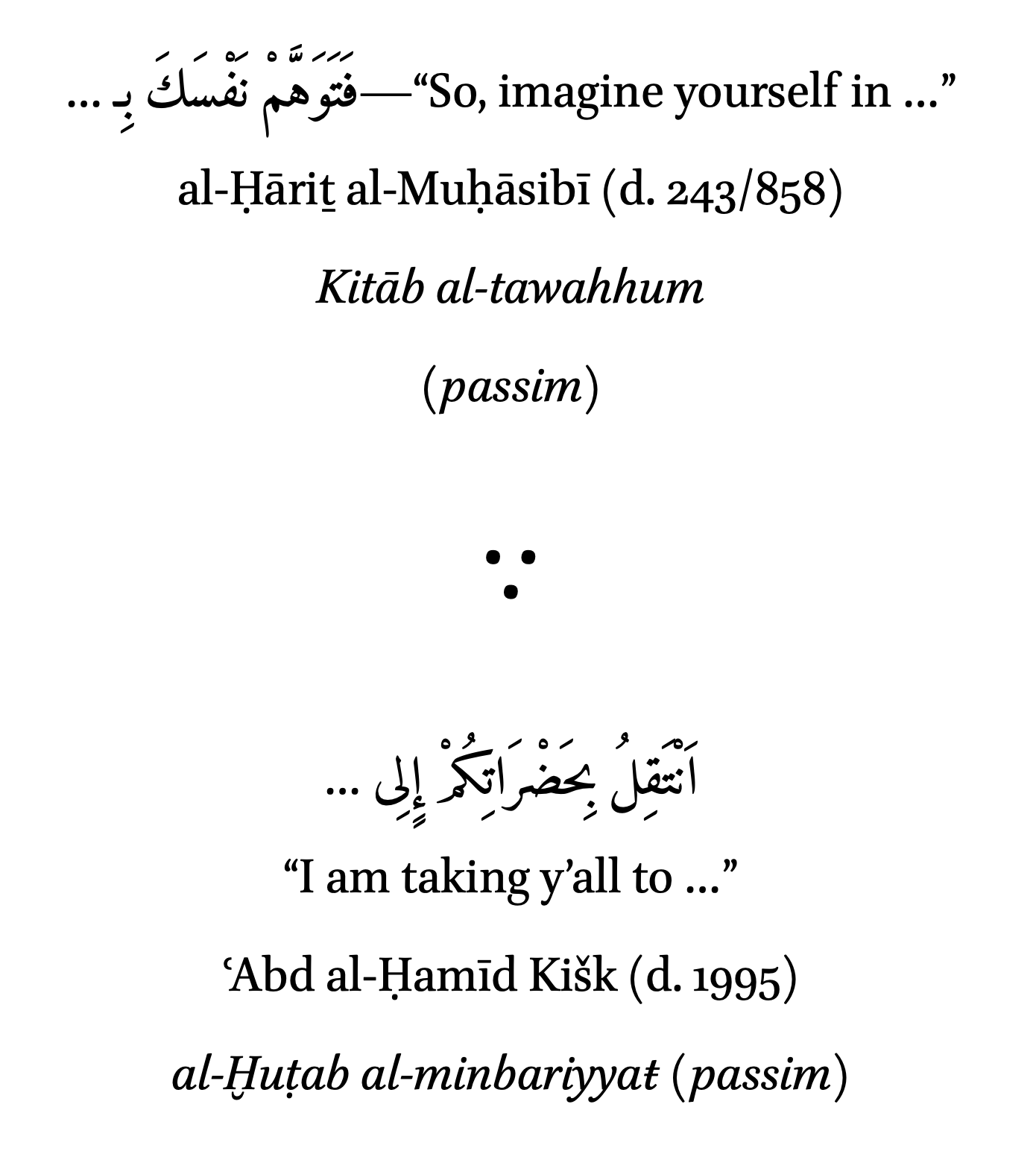
In short, this book asks:
«What does it mean for our field when the entire library becomes a vademecum — something that, quite literally, “goes with me” everywhere?»
Chapter 1
Why we should even bother—a question that remains at the heart of every discussion about the digital.
Chapter 2
How we might go about harnessing the new digital opportunities within the field.
Chapter 3
What we can expect to accomplish: 1) trace term usage 2) model textual typology 3) chart linguistic evolution
Altogether, the book proposes a vision of digital humanities relevant to the field of Arabic and Islamic studies. It argues that this venture is not about cheating, but about keeping up with the rest of the world and ensuring that the future of the field remains in our own hands.
1 / 73
Keys
→spacePgDn
next slide
←PgUp
previous slide
Home / End
first / last
F
fullscreen
O
overview of all slides
S
speaker notes in a second window
T
type tester: fonts, weights, size
+ / − / 0
text larger / smaller / reset
?
this help
Print (⌘P) gives one slide per page. Add #12 to the address to open a slide.