
I am a historian of the Islamic world over the longue durée, with a particular focus on the period from the early Islamic centuries to the late medieval era. My research rests on a simple premise: the Arabic written tradition—biographical collections, chronicles, and local histories above all—is the primary archive for reconstructing the social history of a period from which very few documents survive. These texts are numerous, enormous, and highly formulaic. For a long time these qualities were treated as obstacles. I treat them as evidence.
Large accumulations of historical writing encode social reality indirectly: through repetition, uneven attention, formulaic description, and patterned silence. Who is described at length, who is summarized in a line, and who is omitted altogether tells us how scholarly prestige, institutional affiliation, and geographical position were negotiated across generations. Read one at a time, biographies are anecdotes; read in their tens of thousands, they become a record of how a society organized knowledge about itself. Textual accumulation itself becomes historical evidence.
Working at this scale requires a different kind of reading. Since my dissertation on the Taʾrīḫ al-islām of al-Ḏahabī (d. 748/1348)—a fifty-volume chronicle-cum-biographical collection with almost 30,000 biographies—I have been developing methods of computational analysis for Arabic historical texts. Computers here are instruments of methodological control rather than ends in themselves: they organize large amounts of data, trace recurring structures, and expose distributional patterns that no reader can hold in view. Their value lies in the iterative movement between aggregated observation and close textual reading. One constraint governs all of this work: analytical scale must not come at the expense of historical accountability, so every general observation stays linked to the individual textual attestations behind it.
Current work
My current project, EIS1600, treats about 350 historical and biographical texts—some 100 million words and about 600,000 biographical records, covering c. 130,000 unique individuals (a count still growing as the identification of persons proceeds)—as a single corpus of historical information. Texts are broken into minimal information units, such as the description of a discrete event in a chronicle or a biographical record in a biographical collection, and then reassembled into networks of related historical information. The project asks how scholarly attention concentrates around certain regions, periods, and institutions, how these concentrations shift over time, and what they tell us about the formation, transmission, and legitimation of authority in Islamic societies. The structured data it produces will serve as an engine for research well beyond the project itself.
None of this is possible without a corpus. Since 2014 I have been one of the leaders of the Open Islamicate Texts Initiative, which has grown into the largest machine-readable corpus of texts in classical Arabic: about 8,700 titles by over 3,300 authors, some 861 million words (most conservatively; all texts amount to 2.4 billion words). Around it I have built a series of methodological tools: OpenITI mARkdown, a light-weight annotation scheme conceived as a research method rather than an exchange format; al-Ṯurayyā, a gazetteer and geospatial model of the early Islamic world; and, most recently, the NgramReader and the Book Classification application, two online tools for tracing the use of words and the typology of texts across fourteen centuries.
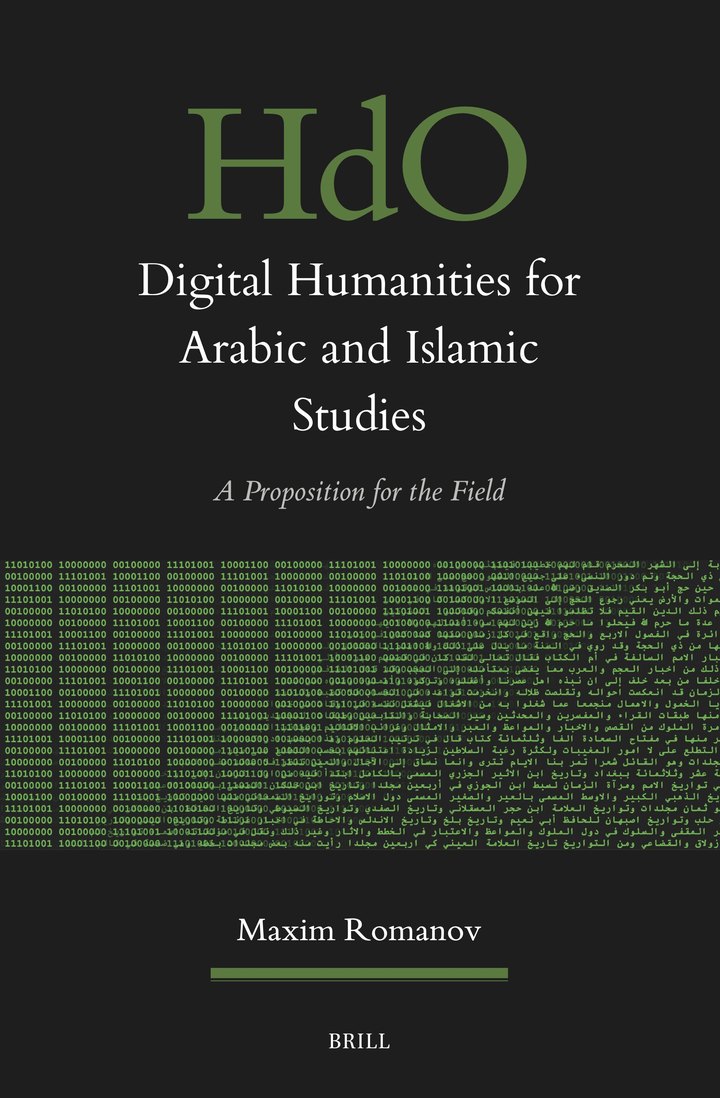
These tools and the arguments behind them come together in my book, Digital Humanities for Arabic and Islamic Studies: A Proposition for the Field (Brill, 2026). Its central claim is that the digital transformation of Arabic and Islamic studies must be led from within, by scholars who understand the texts, the tradition, and the questions, and that computational methods expand rather than replace traditional scholarship.
The next horizon of this work is the typology of the Arabic written tradition itself: how its disciplines emerged, interacted, and changed over time, and how the tradition can be modeled as an internally differentiated and historically evolving system. Rather than relying on inherited bibliographical categories, this line of research derives typological structure from the texts themselves and reads shifts in the organization and prevalence of text types as indicators of broader transformations in scholarly culture.
Background
I was trained in St. Petersburg, first in sociology and then in Arabic and Islamic studies at the Institute of Oriental Manuscripts of the Russian Academy of Sciences, where Stanislav M. Prozorov instilled in me a lasting interest in Arabic biographical literature. I completed my Ph.D. in Near Eastern Studies at the University of Michigan in 2013 under Alexander Knysh. Since then I have held positions at Tufts University (Perseus Project), Leipzig University (Alexander von Humboldt Chair for Digital Humanities), the University of Vienna (Digital Humanities, Department of History), and Aga Khan University in London (the KITAB project), before coming to Hamburg in 2021. The full account is in my CV.