
Maxim Romanov
Curriculum Vitae
The complete record, generated from the same data as the rest of this site. A PDF version is available for download.
- Position
- Emmy Noether Junior Research Group Leader, DFG project “The Evolution of Islamic Societies (c. 600–1600 CE): Algorithmic Analysis into Social History” (EIS1600), Universität Hamburg, Asien-Afrika-Institut
- maxim.romanov [at] uni-hamburg.de
- ORCID
- 0000-0001-7331-3858
- Websites
- eis1600.aai.uni-hamburg.de · maximromanov.github.io
- Download this CV as PDF (typeset from the same data as this page)
Employment
- 2021–2027
Emmy Noether Junior Research Group Leader, DFG project “The Evolution of Islamic Societies (c. 600–1600 CE): Algorithmic Analysis into Social History” (EIS1600), Universität Hamburg, Asien-Afrika-Institut
- 2018–2021
Senior Research Fellow, ERC project “Knowledge, Information Technology, & the Arabic Book” (KITAB), PI Prof. Dr. Sarah Bowen Savant, Aga Khan University–London, Institute for the Study of Muslim Civilisations
- 2017–2021
Universitätsassistent für Digital Humanities, Universität Wien, Institut für Geschichte
- 2015–2017
Research Fellow, Universität Leipzig, Institut für Informatik, Lehrstuhl für Digital Humanities
- 2013–2015
Postdoctoral Associate, Tufts University, Department of Classics & Perseus Project
- 2006–2012
Graduate Student Instructor, University of Michigan, Department of Near Eastern Studies
- 2004–2006
Junior Researcher, Institute of Oriental Manuscripts of the Russian Academy of Sciences (formerly St. Petersburg Branch of the Institute of Oriental Studies), St. Petersburg (IOM RAS)
Education
- 2006–2013
Ph.D. (December 2013) and M.A. (April 2010) in Near Eastern Studies (Arabic & Islamic Studies), University of Michigan, Ann Arbor (official record)
- 2001–2004
Post-graduate program in Islamic Studies, Institute of Oriental Manuscripts of the Russian Academy of Sciences, St. Petersburg
- 1999–2001
St. Petersburg State University, Faculty of Oriental Studies (History of the Arab Countries)
- 1998–2001
Specialist in Sociology (B.A. & M.A. equivalent), St. Petersburg State University, Faculty of Sociology
- 1999–2001
Baltic State Technical University, Faculty of Humanities (Political Science), St. Petersburg
Digital Humanities Projects
- 2021–2027
EIS1600: The Evolution of Islamic Societies (c. 600–1600 CE): Algorithmic Analysis into Social History. Emmy Noether Junior Research Group, DFG (#445975300), Universität Hamburg. Principal investigator. Project page · eis1600.aai.uni-hamburg.de
- 2014–
OpenITI: Open Islamicate Texts Initiative (2014–2016: OpenArabic). Co-PI with Matthew T. Miller (University of Maryland) and Sarah Bowen Savant (Aga Khan University–London). About 8,700 titles by over 3,300 authors, some 861 million words (most conservatively; all texts amount to 2.4 billion words). Project page · github.com/OpenITI
- 2014–
OpenITI mARkdown. A light-weight annotation scheme for Arabic-script texts: structural, morphological, and semantic tagging designed as a research method rather than an exchange format. Description
- 2014–
al-Ṯurayyā Project. A gazetteer (over 2,000 toponyms) and a geospatial model of the early Islamic world, with Masoumeh Seydi. Project page · althurayya.github.io
- 2025
OpenITI NgramReader and Book Classification (T10 model; published as “M10 Book Classification”). Two online applications published as appendices to Digital Humanities for Arabic and Islamic Studies (Brill, 2026). Project page
- 2019–
OpenITI AOCP: Arabic-script OCR Catalyst Project. Co-led with Matthew T. Miller, Sarah Bowen Savant, David Smith, and Raffaele Viglianti; funded by the Andrew W. Mellon Foundation. openiti.org
- 2018–2021
KITAB: Knowledge, Information Technology, and the Arabic Book. ERC project (PI Sarah Bowen Savant); senior research fellow responsible for corpus development and text-reuse analysis. kitab-project.org
- 2015
Classical Arabic Through the Words of the Prophet: A Frequency-Based Ḥadīṯ Reader. Computationally generated teaching materials (Perseus Project & Department of Classics, Tufts University). PDF
Publications
Books
- 2026new
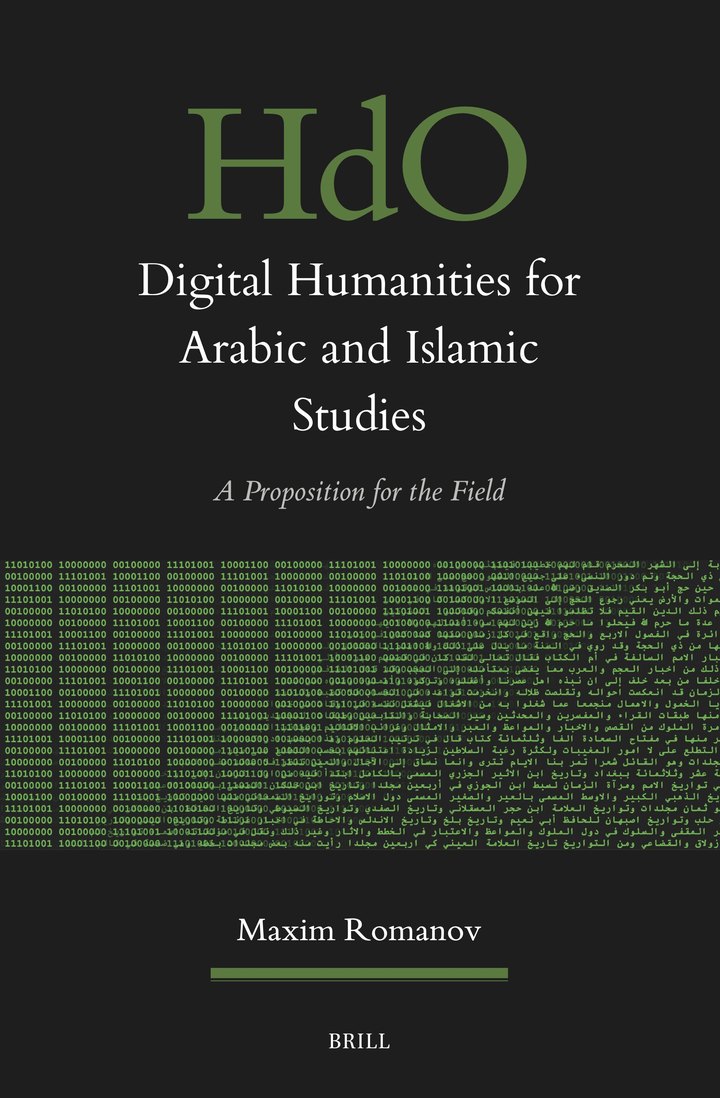
Digital Humanities for Arabic and Islamic Studies: A Proposition for the Field
An open online supplement with all figures from the book, enlargeable for closer examination, is published by Brill on figshare under a CC BY 4.0 licence (DOI 10.6084/m9.figshare.32324454). Two interactive applications accompany the case studies: the OpenITI NgramReader and the Book Classification with the T10 model (published as “M10 Book Classification”).
Abstract
In Digital Humanities for Arabic and Islamic Studies, Maxim Romanov proposes a bold vision for bringing Arabic and Islamic Studies fully into the digital age. Building on the vast OpenITI corpus—over a billion words spanning 1,400 years—Romanov demonstrates how computational tools can illuminate long-term cultural and linguistic developments across the Islamic world. Through accessible case studies on terminology tracing, genre modeling, and linguistic change, the book shows how digital methods expand rather than replace traditional scholarship. Romanov argues that the field’s digital transformation must be led from within—by scholars who understand its texts, traditions, and questions. This book provides both a roadmap and an invitation to rethink how the Arabic and Islamic heritage can be studied in the twenty-first century.
Contents
- Introduction
- A Pitch for Digital Humanities: The Premise · The Inescapable Digital Turn · The Ailment · The Remedy · The Ghost of the Network · The Pitch · The Proposition
- Digital Avatars and Metaobjects: Issues of the Text · Issues of the Corpus · Toward an Engineering Solution · Digital Pragmatism · Approaching Corpus Design · Linked Local Data · Uniform Resource Identifiers · URI-Based Local Structure · Encoding Conventions · Handling Metadata · The Hub That Makes It All Work · Corpus Releases · mARkdown as a Text Annotation Scheme · A Working Subcorpus
- Computational Inquiries: Outlining Practical Premises · Case Study 1, Tracing Term Usage · Case Study 2, Modeling Textual Typology · Case Study 3, Charting Linguistic Evolution
- Afterword · Glossary of Common DH Terms · Bibliography · Index
Brill (order or read online) Online supplement: figures (figshare, open) Appendix 1: NgramReader Appendix 2: Book Classification (T10)
keypeer-reviewed
Articles and Book Chapters
- 2019
- 2019
Studying the History of the Arabic Language: Language Technology and a Large-Scale Historical Corpus
peer-reviewed - 2018
- 2018
- 2017
- 2017
- 2017
Important New Developments in Arabographic Optical Character Recognition (OCR)
keypeer-reviewedopen access - 2016
- 2016
- 2016
- 2014
- 2012
- 2007
- 2005
Electronic Databases on Islam in Arabic, Persian, and English: A Review
peer-reviewed - 2004
- 2009
Ḥadīṯ Reports in Ibn al-Jawzī’s (d. 597/1201) System of Argumentation, Based on His Talbīs Iblīs (“Devil’s Delusions”)
peer-reviewed - 2003
Principles and Procedures of Extracting and Processing Data from Arabic Sources: Historical and Biographical Sources
peer-reviewed
Conference Papers, Proceedings, and Posters
- 2023
Enhancing State-of-the-Art NLP Models for Classical Arabic
PDF (proceedings) ACL Anthology
peer-reviewedopen accessEIS1600 - 2022
Establishing Parameters for Stylometric Authorship Attribution of 19th-Century Arabic Books and Periodicals
peer-reviewed - 2019
- 2019
al-Ṯurayyā, the Gazetteer and the Geospatial Model of the Early Islamic World
keypeer-reviewedopen access - 2019
- 2017
- 2016
Dissertation
- 2013
Computational Reading of Arabic Biographical Collections with Special Reference to Preaching in the Sunnī World (661–1300 CE)
Deep Blue (U of Michigan) PDF (46 MB) Read as a note
key
Working Papers, Preprints, and Teaching Materials
- 2017
Algorithmic Analysis of Medieval Arabic Biographical Collections (preprint)
- 2016
Observations of a Medieval Quantitative Historian? (preprint)
- 2015
Classical Arabic Through the Words of the Prophet: A Frequency-Based Ḥadīṯ Reader
key - 2014
After the Classical World: The Social Geography of Islam (661–1300 CE) (working paper)
Data, Software, and Digital Publications
- 2023
OpenITI: A Machine-Readable Corpus of Islamicate Texts, Primary Version 2023.1.8
key - 2025
ADHFAIS Appendix 1: OpenITI NgramReader (based on OpenITI, release 2023.1.8), version 1
key - 2025
ADHFAIS Appendix 2: M10 Book Classification (based on OpenITI, release 2023.1.8), version 1
key - 2014ongoing
al-Ṯurayyā Project: Gazetteer and Geospatial Model of the Early Islamic World
key - 2014ongoing
OpenITI mARkdown: A Light-Weight Annotation Scheme for Arabic-Script Texts
Description Editor highlighting (Kate)
key - 2015
betaCode for Arabic: Conversion Routines
Invited Talks, Guest Lectures, Keynotes
2026
- September 2026Egypt
Why One Manuscript Needs All The Others: The Case for a Unified Arabic Corpus
- September 2026Germany
Digital Scholarly Communications…
keynote - June 2026Spain
Digital Humanities for Arabic and Islamic Studies: A Proposition for the Field
- May 2026Netherlands
Digital Humanities for Arabic and Islamic Studies: A Proposition for the Field
2025
- December 2025Austria
Modeling Social History of the Islamic World (c. 600–1600 CE) … with Generative LLMs
- April 2025Turkey · online
Islamicate Digital Humanities: What is it and Why Bother?
2024
- November 2024Germany
Future in the Past: Constructing the Social History of the Premodern Islamic World with Modern Computational Methods
- July 2024Germany
A Corpus-Driven Approach in Religious Studies: A Case Of Islam
- July 2024Germany
Digital Humanities in the context of Religious Studies
2023
- November 2023Spain
Teaching Computational Analysis with the ‘Prosopografía de ulemas de al-Andalus’
- October 2023Germany
Arabic biographical collections as a source for modeling social transformations, cultural production, and demography
2022
- April 2022Germany
Made by People, Tied by People: Modeling Islamic Urban Networks from Biographical Data (ca. 600–1300 CE)
- April 2022USA
To DB or not to DB: LOD-like Approach and Algorithmic Analysis
2021
- September 2021Germany
Prospects of Middle Eastern Studies in the Context of Digital Humanities
keynote
2020
- December 2020France · online
OpenITI mARkdown: Between Method and Standard
- November 2020Austria
Computational History and Historiography of the Medieval Islamic World
- November 2020Austria
Data Science & Digital Humanities: Modeling Arabic Written Tradition
- January 2020Austria
Algorithmic Analysis into Social History: A Case of Medieval Islamic History
2019
- September 2019Spain
“The Marvels of Old in the Digital World”: Toward the Methodological Turn in Middle Eastern Studies
- May 2019Lebanon
“Digital Dust of the Arabic Past”: Corpus-Based Research in Arabic & Islamic Studies
keynote - April 2019Russia
Arabic History & Historiography in the Digital Age
- February 2019Hungary
Arabic History & Historiography in the Digital Age
2018
- April 2018Qatar
“Iftaḥ Yā Simsim!” Finding Digital Keys to the Treasures of the Arabic Written Tradition
keynote - February 2018Austria
“Open Sesame!” Digital Analysis of the Arabic Written Tradition: Part I—On Social History
2017
- May 2017Netherlands
The Corpus, The Network, & The Book Continuum
- May 2017Netherlands
Computational Reading of Arabic Biographical Collections
- February 2017USA
Premodern Arabic Biographical Collections: A Digital Approach
- 2017Germany
Arabic Written Tradition & the Digital Humanities
2016
- November 2016USA
From Text to Map: Arabic Biographical Collections and Geospatial Analysis
- June 2016Germany
Future in the Past: Using Modern Computational Methods for the Analysis of Premodern Arabic Texts
- May 2016Germany
Annotation of Geographical Data
- April 2016Germany/USA
Discovering Spatial and Chronological Patterns in Historical Texts
- 2016USA
Writing a 50-volume book in 14th-century Damascus: Algorithmic Analysis, Text Reuse & the Arabic Written Tradition
2015
- December 2015USA/Netherlands
Arabic and Islamic Studies and the Digital Humanities
- February 2015USA
Digital Humanities & the Premodern Islamic World: Of Graphs, Maps, and 30,000 Muslims
- 2015–2016USA/Germany/UK
Of Graphs, Maps, and 30,000 Muslims: Premodern Arabic Texts & the Digital Humanities
2014
- August 2014USA
The Social Geography of the Islamic World (661–1300 CE): on the Method
- April 2014USA
Distant Reading of Arabic Biographical Collections
- April 2014USA
The Social Geography of the Islamic World (661–1300 CE)
- April 2014USA
Future in the Past: Using Digital Methods to Study Medieval Arabic Texts
- April 2014USA
Classical Arabic through the Words of the Prophet: Teaching Classical Arabic in the Digital Age
- March 2014USA
Studying Classical Arabic Sources in the Digital Age: Social Geography & Social History
- February 2014USA
Building a Historical Gazetteer
- February 2014USA
Connectedness of the Islamic World (661–1300 CE)
- 2014USA
Computational Reading of Classical Arabic Sources: the Case of Biographical Collections
Conference Papers and Presentations
2026
- July 2026Belgium
Out of How Many? Numerator Without / With Denominator
2024
- October 2024UK
Navigating Seas of Biographies: A Computational Pipeline for Biography Identification in Historical Corpora (EIS1600 Project Paper)
- September 2024Germany
Data-Driven Periodization of Classical Arabic and the Arabic Written Tradition
- September 2024Germany
A Book of 30,000 Biographies: Computational Analysis of Sources of “The History of Islam” of al-Ḏahabī (d. 748/1348)
- August 2024Armenia
Digital Humanities for Arabic and Islamic Studies: what is it and why bother?
- June 2024USA
Modeling Social History: A Deep Learning Approach to Arabic Historical Tradition
poster - June 2024Germany
Text Reuse in the Arabic Written Tradition: A Case of Biographical Collections
- March 2024UAE
Computational typology of texts as a means of modeling the development of the Arabic written tradition
2023
- December 2023Japan
Ṣundūq al-ġarāʾib fī-l-ʿaṣr al-raqāʾim: Reading Medieval Texts in the Digital Age
- October 2023UK
Modelling the Development of Premodern Islamic Societies from Biographical and Historical Data
- September 2023Bulgaria
Enhancing State-of-the-Art NLP Models for Classical Arabic
- June 2023USA
OpenITI
mARkdown: Balancing Between a Standard and a Research Method - June 2023Germany
Finding and Linking Information in Arabic Historical Texts
- March 2023Germany
Algorithmic Analysis into Social History
2022
- September 2022Germany
Similarity-Based Networks for Islamicate Digital Humanities
- July 2022Germany
Modeling the Development of Premodern Islamic Societies through Computational Analysis of Written Sources
2021
- October 2021Germany
Being Pragmatic: Data and Authority Files in the OpenITI Corpus
- October 2021online
OpenITI: The Corpus for The Field
2020
- October 2020USA · online
One Source to Rule Them All: Constructing the Master Chronicle for Islamic History
- October 2020USA · online
Big Data and Mega Corpora in the Middle East Studies: The Case of Arabic Written Tradition
- August 2020Germany · online
Digital Humanities with non-European sources: The Case of Arabic
- July 2020Germany · online
OpenITI
2019
- October 2019USA/UK
Something Old, Something New, Something Borrowed: Computational Analysis of Writing Practices of Islamic Scholars
- July 2019Netherlands
Open Islamicate Texts Initiative: A Machine-Readable Corpus of Texts Produced in the Premodern Islamicate World
poster - July 2019Netherlands
al-Ṯurayyā, the Gazetteer and the Geo-Spatial Model of the Early Islamic World
- July 2019Netherlands
Orbis-in-a-box (OIB): Modeling Historical Geographical Networks
poster - June 2019Japan · online
Computational Historiography: al-Ḏahabī’s Taʾrīḫ al-islām and His Sources
- April 2019Russia
Interconnectedness of Texts and Computational Modeling of the Arabic Written tradition
- February 2019UK
Modeling Society from Text: a Method in Arabic Studies
2018
- December 2018Spain
al-Ḏahabī’s treatment of his Andalusi sources: toward understanding of compilation methods of medieval historians
- December 2018Netherlands
Prospects of Corpus-Based Research: Computational Methods and the OpenITI Corpus
- May 2018Italy
Modeling Arabic Written Tradition: Enhancing Traditional Text analysis with Computational Techniques
2017
- November 2017USA
Looking for the author behind the words: Stylometric Analysis of al-Ḏahabī’s (d. 1347) Writings
- October 2017Austria
Modeling Social History of the Premodern Islamic World
- September 2017Spain
Digital Humanities in the field of Islamic studies
- May 2017Italy
Why do we need a corpus and computational methods?
- April 2017United Arab Emirates
Algorithmic Analysis of Premodern Arabic Biographical Collections: Approach, Infrastructure, Open Data
- January 2017Germany
80/20: Facilitating Computational Analysis with Named-Entities Recognition
2016
- December 2016Spain
An Accidental Gazetteer: Linked Data for Historical Geography of the Classical Islamic World
- November 2016USA
Of A Network and A Node: ‘The History of Islam’ of al-Ḏahabī (d. 1348) and its place in the Premodern Arabic Textual Tradition
- September 2016USA
Presentation on Islamic[ate] DH Projects at Leipzig University
2015
- October 2015USA
“al-Ḏahabī’s Monster”: Dissecting a 50-Volume Arabic Chronicle-cum-Biographical Collection from the 14th Century CE
- September 2015UK
The Taʾrīḫ al-islām of al-Ḏahabī (d. 748/1347 CE): Computational Exploration of the Life-Cycle of a 50-Volume Arabic Chronicle-cum-Biographical Collection
- July 2015USA
Cultural Production in the Islamic World (600–1900 CE): mining an Ottoman bibliographical collection from the early 20th century
- May 2015USA
Analyzing Arabic Biographical Collections at Scale
- May 2015USA
The Writing Culture of Nīshāpūr in the 11th Century
2014
- November 2014USA
Exploring Islamic Written Legacy: Computational Reading of Hadiyyaŧ al-ʿārifīn
- March 2014USA
Computational Processing of Toponymic Data from classical Arabic Sources
- February 2014USA
Visualizing Islamic Geography at Scale
2013
- October 2013USA
Abstract Models for Islamic History
- October 2013USA
Islamic World Connected (661–1300 CE)
- April 2013USA
Toward Abstract Models for Islamic History
poster - March 2013USA
Exploratory Analysis of Arabic Biographical Collections: the Case of al-Ḏahabī's (d. 1347 CE) Taʾrīḫ al-islām
- February 2013USA
«Connectedness» of the Islamic World (600–1300 CE)
2012
- November 2012USA
Social History of the Muslim World in the Digital Age: Making Sense of 29,000 Biographies from al-Ḏahabī's «History of Islam»
- November 2012USA
Social History of the Muslim World in the Digital Age: Making Sense of 29,000 Biographies from al-Ḏahabī's «History of Islam»
poster - October 2012USA
Writing the Digital History of the Premodern Muslim World, 670–1300 CE: Exploratory Analysis of Primary Sources
- August 2012USA
Mining pre-Modern Islamic Sources
- April 2012Russia
Dreaming Ḥanbalites: Dream-Tales in Prosopographical Dictionaries
- April 2012Belgium
Digital History of the Muslim World: Computer-Aided Analysis of Biographical Dictionaries
2010
- November 2010USA
«Popular» Preaching in the Sunnī Context and the Legitimization of Waʿẓ in the Late 12th Century CE
2009
- November 2009USA
Aḥmad b. Ḥanbal's (d. 241/855) Argumentative Strategies
- April 2009USA
Dreaming Ḥanbalites
2004
- March 2004Russia
The Origins of the Term Ṣūfī
2003
- December 2003Russia
The Paradigm of the Science of Ḥadīṯ (ʿilm al-ḥadīṯ)
- April 2003Russia
Argumentation with Ḥadīṯ Reports in Ibn al-Jawzī’s Talbīs Iblīs (“Devil’s Delusions”)
2002
- April 2002Russia
Ibn al-Jawzī’s Image in the Western Scholarship
Panels, Workshops, and Roundtables Organized
2025
- July 2025Germany
From Classical ML to AI in Arabic and Islamic Studies: A Hands-On Workshop
2024
- September 2024Germany
Stylometry and the Digital Humanities: Unraveling Authorship and Periodization in Arabic Textual Traditions
2022
- September 2022Germany
Computational Contributions to the Social and Cultural Histories of the Islamicate World
2020
- July 2020Austria/UK · online
Stylometry Workshop with Maciej Eder
2019
- June 2019Japan
Approaching Mamlūk Historiography: Narratologically, Literarily, Computationally
2018
- July 2018Austria
ORBIS-esque Hackathon
2017
- November 2017USA
A New Corpus for the Islamicate World and Methods for Its Exploration
2016
- November 2016USA
Networked Texts: New Ways of Seeing the Arabic Textual Tradition (750–1500)
- November 2016USA
Non-traditional methods for Teaching Traditional Languages
2015
- December 2015Germany
Analyzing Text Reuse at Scale / Working with Big Humanities Data
- December 2015Germany
Digital Arabic and Digital Persian Research Workshop
2013
- November 2013USA
Digital Humanities in Middle East Studies
2010
- November 2010USA
Islamic Preaching
Teaching
- 2023–2024Historical methods · DH
Computational Analysis of Data from Audition Certificates, with R
Co-taught in tandem with Konrad Hirschler’s course, using data from the Audition Certificates Platform.
- 2023Historical methods · DH
Digital Humanities in African-Asian Studies: Analysis of Prosopographical Data with R
Built around the Prosopografía de ulemas de al-Andalus (eea.csic.es/pua).
- 2022Historical methods · DH
Text Analysis in R
- 2022Historical methods · DH
Digital Humanities in Middle Eastern Studies
- 2021GIS · DH
GIS Inquiries with R
- 2017–2020Historical methods · DH
DH Methods: Historical Inquiries with R
- 2018–2020DH
Tools and Techniques for Digital Humanities
- 2018History
Of Arabs, Persians and Turks: Patterns of Dynastic Rule in the Islamic World (c. 600–1600 CE)
- 2017–2018History
The Near East at the Time of the First Crusade, 1045–1144
- 2017–2018History
The Medieval Near East and Europe according to Muslims, Christians, and Jews: Comparative Perspectives
- 2016–2017Islamicate texts · DH
Islamicate World 2.0: Studying Islamic Cultures through Computational Textual Analysis
- 2015Classical Arabic · DH
Classical Arabic Through the Words of the Prophet
An introduction to classical Arabic through the corpus of Ḥadīṯ, taught from a frequency-based reader generated for the course.
- 2014–2015Text analysis · DH
Introduction to Text Mining for Students of the Humanities
- 2014History · DH
Mapping the Classical Islamic World
Digital project: mapping data from al-Muqaddasī’s geographical treatise (10th century CE).
- 2012History · DH
The First Millennium of the Islamic Near East, 600–1600 CE
- 2010–2011Religion · History
Introduction to Islam
- 2007–2010Language
Elementary Modern Standard Arabic
- 2006–2007Classical language
Elementary Classical Arabic
Workshops and Summer Schools Taught
- June 2026Spain
Dialogue as Scholarly Practice: the Socratic Method in the Age of AI
- September 2025Switzerland
Summer School on Digital Humanities for Islamic Studies
- July 2025Germany
From Classical ML to AI in Arabic and Islamic Studies: A Hands-On Workshop
- September 2024Germany
Introduction to Digital Humanities in Islamic Studies: A Hands-On Training
- September 2024Spain
Computational Analysis of Andalusian Prosopography
- December 2023Japan
Intensive Workshop in Islamic Digital Humanities
- July 2018Belgium
Digital Islamic Humanities: A 3-Day Intensive Course
- November 2017Netherlands
Workshop on Digital Humanities in Islamic and Arabic Studies
- July 2016Germany
From Text to Map
- February 2015USA
Digital Humanities & Islamic Studies
- October 2014USA
Textual Corpora and the Digital Islamic Humanities
Supervision
- 2025–Ph.D.
Hamid Reza Hakimi
Universität Hamburg, African and Asian Studies · main advisor
- 2022M.A.
Lisa Mischer
Universität Leipzig, Digital Humanities · external advisor
- 2022B.A.
M. Xenia Kudela
Freie Universität Berlin, Arabic Studies · external advisor
- 2022Ph.D.
Masoumeh Seydi
Universität Leipzig, Computer Science / Digital Humanities · external advisor
- 2015B.A. Honors
Cameron Jackson
Tufts University, Computer Science and Arabic Studies
Third-Party Funding
- 2021–2027
Emmy Noether Programme Grant, German Research Foundation (DFG). About €1,900,000
- 2012–2013
Charlotte W. Newcombe Doctoral Dissertation Fellowship, Woodrow Wilson National Fellowship Foundation. $24,000
- 2012
Rackham Research Fellowship, University of Michigan. $3,000
Fellowships, Awards, and Honors
- 2015–2016
Research Fellowship (Visiting Fellow), Islamic Legal Studies Program, Harvard Law School (declined)
- 2013
Hajja Razia Sharif Sheikh Scholarship Award in Islamic Studies, University of Michigan
Service to the Field
- 2021, 2023, 2025
Panel member (SH5 “Cultures and Cultural Production”), ERC Consolidator Grant calls, European Research Council
- 2015–
Reviewer for journals and funding bodies at the intersection of digital humanities, Arabic and Islamic studies, and history. Recent reviews for Journal of Abbasid Studies, Journal of Digital Islamicate Research, Digital Scholarship in the Humanities, Temenos, Journal of Law and Religion
- 2013–
Regular consultation on the design of digital projects in the historical study of the Islamic world, including over a dozen ERC-funded and academy projects in the US, Canada, the UK, the Netherlands, Belgium, Spain, Italy, Israel, Japan, Austria, and Germany
Professional Membership
- 2024–
Union Européenne des Arabisants et Islamisants (UEAI)
- 2023–
School of Abbasid Studies (SAS)
- 2016–
Middle East Medievalists (MEM)
- 2012–
American Oriental Society (AOS)
- 2008–
Middle East Studies Association (MESA)
Skills
- Languages
Russian (native) · Arabic (advanced, modern standard and classical) · English (near-native) · German (B1) · French (reading)
- Computing
R, Python, QGIS, LaTeX; cluster computing; machine learning