Maxim Romanov

Books, Articles, Data

Publications

Books, articles, book chapters, conference papers, and citable data and software. PDFs are provided where the publisher’s terms allow; author versions are marked as such.
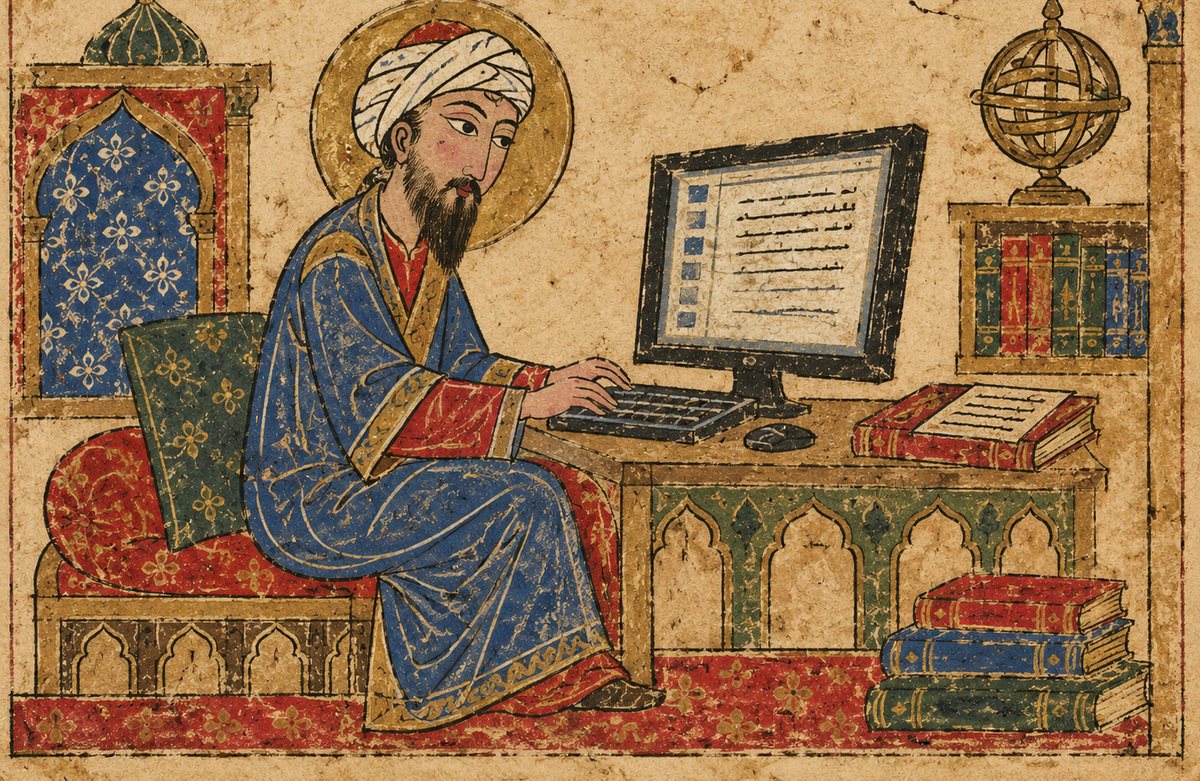
A scholar in a turban and blue robe sits on a cushioned bench working at a desktop computer, with books and an armillary sphere behind him, painted in the manner of a medieval Arabic manuscript
After a Kalīla wa-Dimna manuscript · AI-generated

key key contribution to digital humanities in the field · peer-reviewed · open access · EIS1600 project output

Books

  1. 2026new
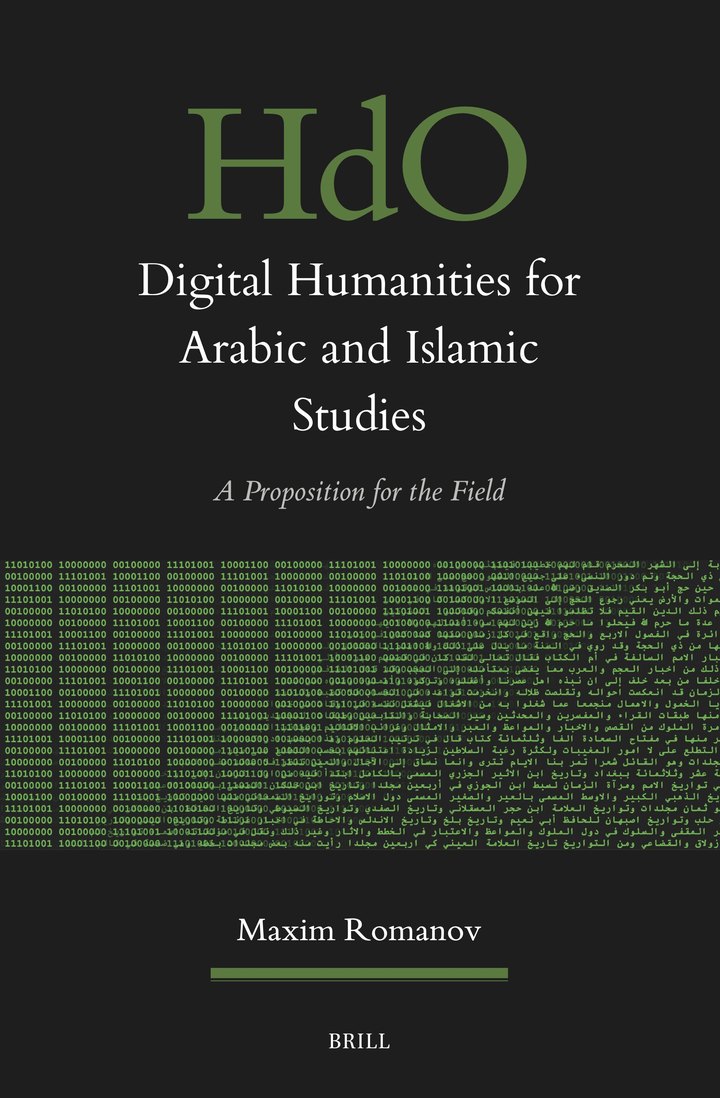
    Cover of Digital Humanities for Arabic and Islamic Studies: A Proposition for the Field

    Digital Humanities for Arabic and Islamic Studies: A Proposition for the Field

    Handbook of Oriental Studies, Section 1: The Near and Middle East, vol. 199. Leiden and Boston: Brill, 2026. E-book (PDF) published 1 September 2026, ISBN 978-90-04-76053-0; hardback 1 October 2026, ISBN 978-90-04-76052-3

    An open online supplement with all figures from the book, enlargeable for closer examination, is published by Brill on figshare under a CC BY 4.0 licence (DOI 10.6084/m9.figshare.32324454). Two interactive applications accompany the case studies: the OpenITI NgramReader and the M10 Book Classification.

    Abstract

    In Digital Humanities for Arabic and Islamic Studies, Maxim Romanov proposes a bold vision for bringing Arabic and Islamic Studies fully into the digital age. Building on the vast OpenITI corpus—over a billion words spanning 1,400 years—Romanov demonstrates how computational tools can illuminate long-term cultural and linguistic developments across the Islamic world. Through accessible case studies on terminology tracing, genre modeling, and linguistic change, the book shows how digital methods expand rather than replace traditional scholarship. Romanov argues that the field’s digital transformation must be led from within—by scholars who understand its texts, traditions, and questions. This book provides both a roadmap and an invitation to rethink how the Arabic and Islamic heritage can be studied in the twenty-first century.

    Contents
    • Introduction
      1. A Pitch for Digital Humanities: The Premise · The Inescapable Digital Turn · The Ailment · The Remedy · The Ghost of the Network · The Pitch · The Proposition
      1. Digital Avatars and Metaobjects: Issues of the Text · Issues of the Corpus · Toward an Engineering Solution · Digital Pragmatism · Approaching Corpus Design · Linked Local Data · Uniform Resource Identifiers · URI-Based Local Structure · Encoding Conventions · Handling Metadata · The Hub That Makes It All Work · Corpus Releases · mARkdown as a Text Annotation Scheme · A Working Subcorpus
      1. Computational Inquiries: Outlining Practical Premises · Case Study 1, Tracing Term Usage · Case Study 2, Modeling Textual Typology · Case Study 3, Charting Linguistic Evolution
    • Afterword · Glossary of Common DH Terms · Bibliography · Index
    keypeer-reviewed

Articles and Book Chapters

  1. 2019

    1001 Morphological Patterns: Algorithmically Generated Materials for Teaching Classical Arabic

    In Innovations and Traditions in Arabic and Islamic Studies: A Festschrift in Honor of Professor Oleg I. Red’kin, 262–274. St. Petersburg: St. Petersburg University Press, 2019

    peer-reviewed
  2. 2019

    Studying the History of the Arabic Language: Language Technology and a Large-Scale Historical Corpus

    Yonatan Belinkov*, Alexander Magidow*, Alberto Barrón-Cedeño, Avi Shmidman, and Maxim Romanov (* equal contribution) · Language Resources and Evaluation 53 (2019): 771–805. Springer

    peer-reviewed
  3. 2018

    A Digital Humanities for Premodern Islamic History

    Roundtable on Digital Humanities, International Journal of Middle East Studies 50, no. 1 (2018): 129–134. Cambridge University Press

    keypeer-reviewed
  4. 2018

    Digitizing the Textual Heritage of the Premodern Islamicate World: Principles and Plans

    Matthew Thomas Miller, Maxim G. Romanov, and Sarah Bowen Savant (alphabetically) · Roundtable on Digital Humanities, International Journal of Middle East Studies 50, no. 1 (2018): 103–109. Cambridge University Press

    keypeer-reviewed
  5. 2017

    Algorithmic Analysis of Medieval Arabic Biographical Collections

    Speculum 92, no. S1 (2017): S226–S246

    keypeer-reviewedopen access
  6. 2017

    Observations of a Medieval Quantitative Historian?

    Der Islam 94, no. 2 (2017): 462–495

    keypeer-reviewed
  7. 2017

    Important New Developments in Arabographic Optical Character Recognition (OCR)

    Benjamin Kiessling, Matthew Thomas Miller, Maxim Romanov, and Sarah Bowen Savant (alphabetically) · al-ʿUṣūr al-Wusṭá: The Journal of Middle East Medievalists 25 (2017): 1–13

    keypeer-reviewedopen access
  8. 2016

    After the Classical World: The Social Geography of Islam (c. 600–1300 CE)

    In Ars Islamica: Festschrift in Honor of Stanislav Mikhailovich Prozorov, edited by Mikhail Piotrovsky and Alikber Alikberov, 247–277. Moscow: Vostochnaya Literatura (Russian Academy of Sciences, Institute of Oriental Studies), 2016

    keypeer-reviewed
  9. 2016

    Digital Age, Digital Methods

    In Ars Islamica: Festschrift in Honor of Stanislav Mikhailovich Prozorov, edited by Mikhail Piotrovsky and Alikber Alikberov, 129–156. Moscow: Vostochnaya Literatura (Russian Academy of Sciences, Institute of Oriental Studies), 2016

    peer-reviewed
  10. 2016

    Toward Abstract Models for Islamic History

    In The Digital Humanities and Islamic & Middle East Studies, edited by Elias Muhanna, 117–149. Berlin: De Gruyter, 2016. ISBN 978-3-11-037454-4

    keypeer-reviewed
  11. 2014

    Toward the Digital History of the Pre-Modern Muslim World: Developing Text-Mining Techniques for the Study of Arabic Biographical Collections

    In Analysis of Ancient and Medieval Texts and Manuscripts: Digital Approaches, edited by Tara L. Andrews and Caroline Macé, 229–244. Turnhout: Brepols, 2014

    peer-reviewed
  12. 2012

    Dreaming Ḥanbalites: Dream-Tales in Prosopographical Dictionaries

    In Dreams and Visions in Islamic Societies, edited by Özgen Felek and Alexander Knysh, 31–50. Albany: SUNY Press, 2012. ISBN 978-1-4384-3993-8

    peer-reviewed
  13. 2007

    The Term Ṣūfī: Spiritualizing Simple Words

    Pismennyie Pamyatniki Vostoka / Written Monuments of the Orient 5 (2007): 149–159

    peer-reviewed
  14. 2005

    Electronic Databases on Islam in Arabic, Persian, and English: A Review

    Stanislav M. Prozorov and Maxim Romanov · Pismennyie Pamyatniki Vostoka / Written Monuments of the Orient 2, no. 3 (2005): 240–257. With a summary in English · in Russian

    peer-reviewed
  15. 2004

    The Paradigm of the Science of Ḥadīṯ (ʿilm al-ḥadīṯ)

    Vostok / Oriens 5 (2004): 5–11. With a summary in English · in Russian

    peer-reviewed
  16. 2009

    Ḥadīṯ Reports in Ibn al-Jawzī’s (d. 597/1201) System of Argumentation, Based on His Talbīs Iblīs (“Devil’s Delusions”)

    Khristianskii Vostok / Christian Orient, n.s. 5 (XI) (2009): 310–316. Moscow: Indrik (Russian Academy of Sciences and the State Hermitage). Accepted for publication in 2003 · in Russian

    peer-reviewed
  17. 2003

    Principles and Procedures of Extracting and Processing Data from Arabic Sources: Historical and Biographical Sources

    Stanislav M. Prozorov and Maxim Romanov · Vostok / Oriens 4 (2003): 117–127. With a summary in English · in Russian

    peer-reviewed

Conference Papers, Proceedings, and Posters

  1. 2023

    Enhancing State-of-the-Art NLP Models for Classical Arabic

    Tariq Yousef, Lisa Mischer, Hamid Reza Hakimi, and Maxim Romanov · In Proceedings of the Ancient Language Processing Workshop (RANLP 2023, Varna, 8 September 2023), 160–169

    peer-reviewedopen accessEIS1600
  2. 2022

    Establishing Parameters for Stylometric Authorship Attribution of 19th-Century Arabic Books and Periodicals

    Till Grallert and Maxim Romanov · In Digital Humanities 2022: Book of Abstracts (University of Tokyo), 346–348

    peer-reviewed
  3. 2019

    Open Islamicate Texts Initiative: A Machine-Readable Corpus of Texts Produced in the Premodern Islamicate World (poster)

    Maxim Romanov, Matthew Thomas Miller, Sarah Bowen Savant, and Masoumeh Seydi · In Digital Humanities 2019 Conference Papers (Utrecht University, 9–12 July 2019)

    The poster won the Utrecht Centre for Digital Humanities award for innovative and interdisciplinary research.

    keypeer-reviewedopen access
  4. 2019

    al-Ṯurayyā, the Gazetteer and the Geospatial Model of the Early Islamic World

    Maxim Romanov and Masoumeh Seydi · In Digital Humanities 2019 Conference Papers (Utrecht University, 9–12 July 2019)

    keypeer-reviewedopen access
  5. 2019

    Orbis-in-a-Box (OIB): Modeling Historical Geographical Networks (poster)

    Maxim Romanov, Masoumeh Seydi, James Baillie, Karl Grossner, and Rainer Simon · In Digital Humanities 2019 Conference Papers (Utrecht University, 9–12 July 2019)

    keypeer-reviewedopen access
  6. 2017

    Premodern Geographical Description: Data Retrieval and Identification

    Masoumeh Seydi, Maxim Romanov, and Chiara Palladino (alphabetically) · In Proceedings of the 11th Workshop on Geographic Information Retrieval (GIR’17), 4:1–4:10. New York: ACM Press, 2017

    peer-reviewed
  7. 2016

    Shamela: A Large-Scale Historical Arabic Corpus

    Yonatan Belinkov, Alexander Magidow, Maxim Romanov, Avi Shmidman, and Moshe Koppel (alphabetically) · In Proceedings of the Workshop on Language Technology Resources and Tools for Digital Humanities (LT4DH), 45–53. Osaka, 11–17 December 2016

    peer-reviewedopen access

Dissertation

  1. 2013

    Computational Reading of Arabic Biographical Collections with Special Reference to Preaching in the Sunnī World (661–1300 CE)

    Ph.D. dissertation, University of Michigan, 2013

    key

Working Papers, Preprints, and Teaching Materials

Author versions and unpublished texts; cite the published versions where they exist.

  1. 2017

    Algorithmic Analysis of Medieval Arabic Biographical Collections (preprint)

    Leipzig University, May 2017. Published in Speculum 92 (2017)

  2. 2016

    Observations of a Medieval Quantitative Historian? (preprint)

    Leipzig University, September 2016. Published in Der Islam 94 (2017)

  3. 2015

    Classical Arabic Through the Words of the Prophet: A Frequency-Based Ḥadīṯ Reader

    Perseus Project & Department of Classics, Tufts University, 2015. A computationally generated introduction to the language of Ḥadīṯ (205 pages)

    key
  4. 2014

    After the Classical World: The Social Geography of Islam (661–1300 CE) (working paper)

    Tufts University, April 2014. Published in Ars Islamica (2016)

Data, Software, and Digital Publications

Corpora, tools, and online applications with citable releases.

  1. 2023

    OpenITI: A Machine-Readable Corpus of Islamicate Texts, Primary Version 2023.1.8

    Lorenz Nigst, Maxim Romanov, Sarah Bowen Savant, Masoumeh Seydi, and Peter Verkinderen · Zenodo, 2023. Data set. About 8,700 unique titles by over 3,300 authors; some 861 million words (2.4 billion with all versions)

    key
  2. 2025

    ADHFAIS Appendix 1: OpenITI NgramReader (based on OpenITI, release 2023.1.8), version 1

    Zenodo, 2025. An online application for tracing the use of words and phrases across the Arabic written tradition; companion to Digital Humanities for Arabic and Islamic Studies

    key
  3. 2025

    ADHFAIS Appendix 2: M10 Book Classification (based on OpenITI, release 2023.1.8), version 1

    Zenodo, 2025. An experiment in soft classification of the works of the Arabic written tradition against ten types of texts

    key
  4. 2014ongoing

    al-Ṯurayyā Project: Gazetteer and Geospatial Model of the Early Islamic World

    Maxim Romanov and Masoumeh Seydi · althurayya.github.io. Over 2,000 toponyms and route sections georeferenced from Georgette Cornu’s Atlas du monde arabo-islamique à l’époque classique

    key
  5. 2014ongoing

    OpenITI mARkdown: A Light-Weight Annotation Scheme for Arabic-Script Texts

    Structural, morphological, and semantic tagging designed as a research method; the format of the OpenITI corpus

    key
  6. 2015

    betaCode for Arabic: Conversion Routines

    Python scripts for typing fully vocalized Arabic in ASCII and converting it into Arabic script and several transliteration schemes