
Maxim Romanov

Working Notes, 2013–

Notes

Shorter pieces written alongside the research: methods, data, maps, tools, and occasional reflections on the field. The older notes were first published on the previous version of this site, al-Raqmiyyāt.
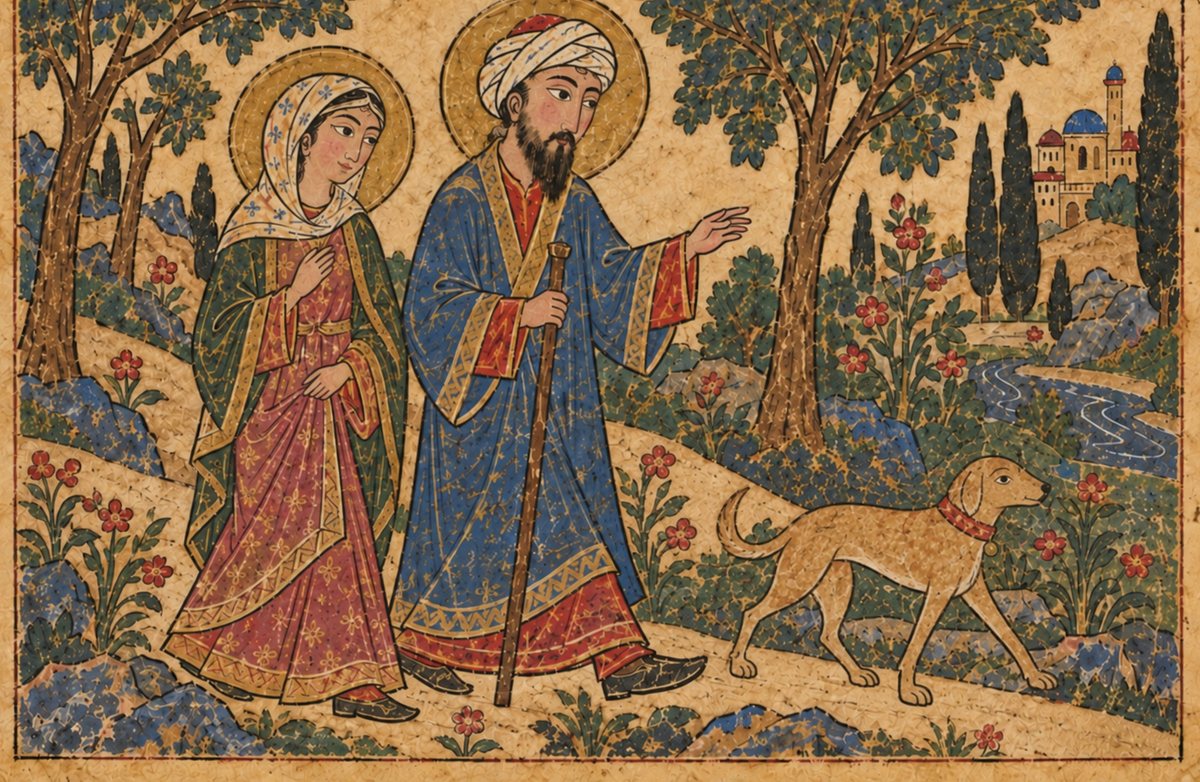
Two figures and a dog walk along a path between flowering trees toward a domed town, painted in the manner of a medieval Arabic manuscript
After a Kalīla wa-Dimna manuscript · AI-generated
  1. June 2023

    EIS1600: Emmy Noether Junior Research Group (DFG)

    In the course of the first millennium of its history (c. 600–1600 CE), Islamic society evolved from a simple tribal polity into a multifaceted social, cultural, and political entity that stretched from Spain and North Africa in the West to Central Asia and Ind…

  2. November 2017

    The Network of MESA (2009–2017)

    The Middle East Studies Association (MESA) celebrated its 50th anniversary last year. Although it is not as large as such associations as AAR and AHA, it is very dear to most of us who are engaged in the study of Middle East.

  3. October 2017

    A Digital Humanities for Premodern Islamic History

    Defining digital humanities is tricky. Our scholarship has been intrinsically digital for quite a few decades already, as we rely more and more on electronic storage to save, word processors to write, bibliography managers to organize, databases to consult, di…

  4. October 2017

    Cultural Production in the Islamic World

    Biographical and bibliographical texts can offer a valuable insight into the process of cultural production in the Islamic world.

  5. October 2016

    Arabographic Optical Character Recognition (OCR)

    The OpenITI team—building on the foundational open-source OCR work of the Leipzig University’s (LU) Alexander von Humboldt Chair for Digital Humanities—has achieved Optical Character Recognition (OCR) accuracy rates for classical Arabic-script texts in the hig…

  6. May 2016

    Creating Frequency-Based Readers for Classical Arabic

    Learning classical Arabic is a long process. (One of my University of Michigan professors once joked that it is hard only for the first ten years—after that it gets worse.) Most of us took great pleasure in advanced reading classes with our professors.

  7. March 2016

    Chronological Coverage of an Arabic Corpus

    While looking for a way to identify all biographical collections and chronicles (and, by extension, all other texts that offer data for time-series analysis) in a collection of 0ver 10,000 texts, it occurred to me that all these texts share the same common fea…

  8. November 2015

    Introducing OpenArabic mARkdown

    TEI XML has long become the standard for tagging humanistic texts for research purposes. It is the standard in most digital libraries (including the Perseus Digital Library).

  9. October 2015

    Distant Reading & the Islamic Archive

    On October 16, 2015, the Digital Islamic Humanities Program at Brown University held its third annual scholarly gathering, a symposium on the subject “Distant Reading & the Islamic Archive.”

  10. April 2015

    Mapping the Greco-Roman World

    “Envy is not a very good thing. Yet envy is precisely what an early Islamicist feels when he reads Roger Bagnall and Bruce Frier’s The Demography of Roman Egypt.” [^fn1] These words stuck in my head since the very moment I read them and over the past two years…

  11. February 2015

    BetaCode for Arabic

    Although both Windows and Mac OS now support Arabic, it is still quite difficult to type and edit Arabic texts. It is particularly frustrating to edit and manipulate fully vocalized texts, since most fonts either render “short vowels” (ḥarakāt) invisible, or do not render them properly. Because of the “stacking,” i.e. “short vowels” being placed on top of letters and on top of each other, it becomes impossible to edit texts and one is often forced to go into delete-and-retype mode (and there is still no guarantee, because of visual issues, that all the letters and “short vowels” will actually be in the right order). betaCode can make it easy to type fully-vocalized Arabic texts on any machine through the use of simple character combinations and automatic rendering into various transliteration schemes and the Arabic script (scroll below for examples).

  12. August 2014

    Islamic Urban Centers (661–1300 CE)

    Back to al-Ḏahabī’s Taʾrīḫ al-islām. The present dynamic cartogram shows how the prominence of major urban centers was changing over time.

  13. February 2014

    Computational Reading of Arabic Biographical Collections: Dissertation online @ U of Michigan

    A project in the digital humanities, the dissertation explores methods of computational text analysis. Relying on text-mining techniques to extract meaningful data from unstructured text, the study offers an effective and flexible method for the analysis of Arabic biographical collections, the most valuable source for the social history of the pre-modern Islamic world. It uses the largest collection, “The History of Islam” of al-Ḏahabī (d. 1348), as a case-study of applying the new method and shows how almost 30,000 biographies can be studied as a whole.

  14. November 2013

    Toward Abstract Models for Islamic History

    The advent of digital humanities has brought the notion of “big data” into the purview of humanistic inquiry. Humanists now have access to huge corpora that open research possibilities that were unthinkable a decade or two ago. However, working with corpora requires a rather different approach that is more characteristic of sciences than humanities. Namely, one has to be transparent and explicit with regard to how data are extracted and how they are analyzed. Text-mining techniques rely on explicit algorithms because they help tracing mistakes, correcting them and, ultimately, improving results.

  15. February 2013

    The Encyclopaedia of Arabic Poetry

    Prepared in cooperation with Michael Bonner (U of Michigan) In 1997, Cultural Foundation in Abu Dhabi (http://www.adach.ae) started development of an extremely useful multimedia Encyclopaedia of [Arabic] Poetry (al-Mawsūʿa al-Shiʿriyya).

  16. January 2013

    Islamic World, 661-1300 CE

    Evenly spaced across the entire period of 41–700 AH/661–1300 CE, the following series of four maps (click to enlarge) visualizes the frequencies of top 100 toponyms mentioned in biographies of al-Ḏahabī’s Taʾrīḫ al-islām: almost 13,000 biographies (44,4%); altogether these locations are mentioned in slightly over 25,000 biographies. Only biographies that mention these places are been counted, i.e. if a certain place is mentioned several times in a specific biography it is counted only once.

  17. January 2013

    Python Functions for Arabic

    There are certain operations one has to repeat many times while manipulating Arabic text. For a number of purposes Arabic text must be normalized, namely “noise” characters deleted, the orthography of problematic letters unified, etc.